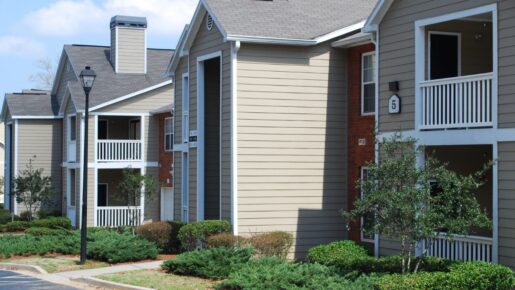
A California startup is partnering with Nvidia and one of the nation’s largest homebuilders to install compact AI computing units outside new residential homes, tapping into existing household electrical capacity to meet surging demand for data processing power.
The units, known as XFRA nodes, contain enterprise-grade hardware capable of running AI workloads. Initial deployments are planned in new communities built by PulteGroup, with broader rollout targeted for later this year and scaling ambitions in the years ahead.
“They are about the size of an HVAC condenser installed just outside of single-family homes today,” a spokesperson for Span explained to Realtor.com.
Span, founded in San Francisco in 2018, specializes in smart electrical panels for homes. The company announced the XFRA distributed data center solution in April 2026 in partnership with Nvidia. Each node includes 16 Nvidia RTX Pro 6000 Blackwell Server Edition GPUs, four AMD EPYC CPUs, and three terabytes of memory, housed in a liquid-cooled Dell server setup designed to operate with minimal noise.
How Homeowners Participate
The approach uses spare electrical capacity already present in many neighborhoods, managed through Span’s smart panels, backup batteries, and sometimes solar integration, per Scientific American.
Homeowners do not purchase or pay for the XFRA hardware, smart electrical panel, or backup battery — all of which Span installs at no upfront cost, per Realtor.com.
Contrary to some social media claims suggesting that homeowners hosting XFRA nodes earn significant passive income or “get paid” to participate, the model involves homeowners paying Span a flat monthly fee—typically cited as around $150—that covers their full electricity and high-speed internet/Wi-Fi service, with Span directly paying the utility and ISP bills.
Homeowners may receive additional compensation based on the node’s actual energy and compute usage, but the net result is generally lower overall monthly utility costs compared to standard household bills, rather than net profit beyond those savings.
Details can vary by location, usage, and contract, and exact terms are still being refined through ongoing pilots.
Current Status and Limitations
Span states it can deploy 8,000 such units approximately six times faster and at one-fifth the cost of constructing a comparable 100-megawatt traditional data center. The company aims to scale the network toward more than one gigawatt of distributed compute capacity.
Prototype testing has already occurred with paying customers. A larger proof-of-concept trial involving about 100 homes, totaling roughly 1.2 megawatts, is scheduled for this fall in the southwestern U.S. (likely Nevada or Arizona).
U.S. data centers consumed 4.4% of the nation’s electricity in 2023 and are projected to consume between 6.7% and 12% by 2028 — a potential doubling to tripling — according to a Lawrence Berkeley National Laboratory report.
Nvidia’s Marc Spieler, Senior Managing Director of Global Energy Industry, said in Span’s announcement that the solution addresses needs for low-latency inference workloads while making compute more accessible.
Additionally, the XFRA system addresses a critical bottleneck in the AI industry: the widening “speed-to-power gap,” in which explosive demand for computing capacity far outpaces the electrical grid’s ability to support new large-scale data centers.
Traditional data center projects often face four- to seven-year delays for grid interconnection and substation upgrades, while more than 2,000 gigawatts of generation and storage sit in interconnection queues nationwide, reported Scientific American.
By tapping into underutilized residential electrical capacity—homes typically use only about 40% of their allocated power on average—Span’s distributed XFRA nodes deliver AI inference workloads much faster and at roughly one-fifth the cost of building a comparable centralized facility.
The concept has drawn attention as AI growth strains power infrastructure. Similar distributed approaches aim to utilize underused residential grid capacity rather than relying solely on massive centralized facilities, which have faced local opposition in some areas over land use, noise, and energy demands.
This initiative remains in the early stages, focused initially on new construction. It is not yet available for retrofitting existing homes nationwide. Details on exact compensation levels, long-term contracts, and impacts on local utility rates continue to develop as pilots advance.