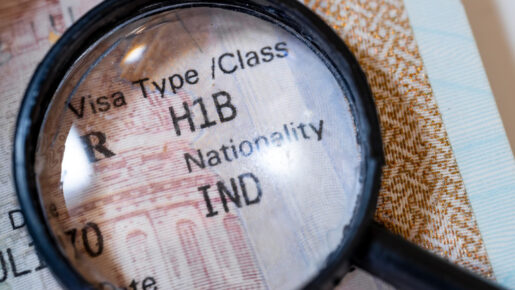


A new immigration bill in Congress could make it significantly easier for foreign students who earn a PhD in science, engineering, math, medicine, or healthcare from American universities to stay and work in the U.S. without going through the usual H-1B visa lottery.
The DIGNIDAD Act (Dignity for Immigrants while Guarding our Nation to Ignite and Deliver the American Dream Act), introduced by Rep. Maria Elvira Salazar (R-FL), would allow these U.S.-educated graduates to qualify for an O-1 “extraordinary ability” visa based largely on their U.S. doctorate.
Unlike the capped and competitive H-1B program, the O-1 visa has no annual limit, no lottery, and fewer rules requiring employers to pay the standard U.S. wage, as The Dallas Express previously reported.
Supporters say the change would help America keep brilliant graduates who might otherwise be forced to leave after finishing school. Critics worry it could give companies an easier, cheaper way to hire foreign workers instead of American ones — especially at a time when many U.S. STEM graduates are already struggling to find good jobs.
This provision is sparking debate over whether the bill truly protects American workers or simply opens another door for unlimited high-skilled immigration.
Under Section 3303 of the bill, a U.S. PhD would create a presumption of eligibility under the “extraordinary ability” standard, which historically has required extensive documentation of sustained national or international acclaim. Supporters say the change would help retain highly educated graduates who might otherwise be forced to leave the United States after completing their studies.
“This ensures that individuals who earned PHD’s in high-demand STEM and healthcare fields in the U.S. can apply for an O visa and use their talents here if they want to,” Salazar’s office wrote in a section-by-section summary of the proposal.
A Center for Immigration Studies analysis indicated that the bill would create “numerically unlimited temporary work visas” for PhD graduates “with no prevailing wage requirement,” potentially increasing competition for U.S. workers.
Federal data cited from the State Department shows O-1 visa issuances have already risen sharply in recent fiscal years:
| Visa Class | Description | 2020 | 2021 | 2022 | 2023 | 2024 |
|---|---|---|---|---|---|---|
| O-1 | Extraordinary ability | 8,838 | 7,294 | 19,102 | 18,994 | 19,457 |
| O-2 | Support personnel | 3,919 | 2,870 | 11,586 | 13,335 | 13,922 |
| O-3 | Family members | 2,658 | 2,838 | 6,234 | 6,453 | 6,035 |
At the same time, market conditions have been challenging for American workers. Data from the Federal Reserve Bank of New York, based on 2024 figures and released February 4, 2026, show elevated unemployment and underemployment across several STEM fields, including computer science and physics, where roughly 1/4 and 1/3 of workers are unemployed or underemployed.
| Major | Unemployment Rate | Underemployment Rate | Median Wage Early Career | Median Wage Mid-Career | Share With Graduate Degree |
|---|---|---|---|---|---|
| Mathematics | 5.8% | 26.2% | $70,000 | $100,000 | 51.3% |
| Mechanical Engineering | 4.4% | 20.1% | $80,000 | $120,000 | 39.1% |
| Medical Technicians | 6.2% | 47.0% | $62,000 | $80,000 | 24.7% |
| Miscellaneous Biological Science | 4.4% | 46.9% | $46,000 | $80,000 | 59.5% |
| Computer Engineering | 7.8% | 15.8% | $90,000 | $131,000 | 39.4% |
| Computer Science | 7.0% | 19.1% | $87,000 | $120,000 | 32.7% |
| Physics | 6.6% | 29.1% | $67,000 | $105,000 | 67.3% |
Congressional press releases supporting the DIGNIDAD Act argue the policy targets specific shortages, particularly in healthcare.
However, the healthcare industry is already a major user of the H-1B program, and lawmakers have moved separately to ease hiring constraints. The Dallas Express previously reported that the president indicated that doctors may get “national interest” exemptions from the recent $100,ooo H-1B application fee, and there is pending legislation in Congress to permanently prevent healthcare employers from bearing these costs.
Moreover, public universities, major employers of PhD-level professionals, are already exempt from the 85,000-per-year numerical cap under the H-1B system. In other words, the DIGNIDAD Act adds another uncapped pathway for hiring white-collar foreign labor, in some circumstances.
Other provisions in the DIGNIDAD Act aim to offset workforce concerns by directing funding into domestic training. Section 2403 would allocate 10% of new program funds into the H-1B Nonimmigrant Petitioner Account, which supports job training, scholarships, and STEM education, while the remaining 90% would fund apprenticeships and workforce grants.
The proposal comes amid broader uncertainty surrounding high-skilled immigration policy. Consultancies are already marketing the O-1A , a subcategory of the O visa class for extraordinary ability in sciences, education, business, or athletics, as a workaround for Indian aliens frustrated with the H-1B process, The Dallas Express reported.
Other firms have pitched the EB-5 visa, an investor visa that provides legal status in exchange for reported financial investment in the country, as another means for aliens to avoid the H-1B process, The Dallas Express reported.
The H-1B visa is dominated by Asian nationals. 72% of H-1B visas are awarded to workers from India, while 12% going to those from China, according to federal data.
The recipients of the O-1 visa are relatively more diverse under the current system. The largest recipients of the visa by national origin are Britain, Brazil, India, China, and Mexico, according to 2024 State Department data.
The H-1B visa allows U.S. employers to temporarily hire foreign workers in specialty occupations that typically require specialized knowledge and at least a bachelor’s degree. The O-1 visa is for individuals who demonstrate extraordinary ability in the sciences, arts, education, business or athletics.
As of now, the bill remains introduced (referred to committees in July 2025) and has gained additional cosponsors (around 35+ reported earlier in 2026). It has not passed and faces the usual hurdles in a divided Congress.