

During a joint meeting between the Dallas City Council and Dallas Area Rapid Transit officials, it was revealed that the agency continues to face challenges with low ridership.
The council’s Transportation and Infrastructure Committee met with DART officials on December 2 for a quarterly update. They learned DART’s ridership has never recovered from the drop during COVID-19 in 2020.
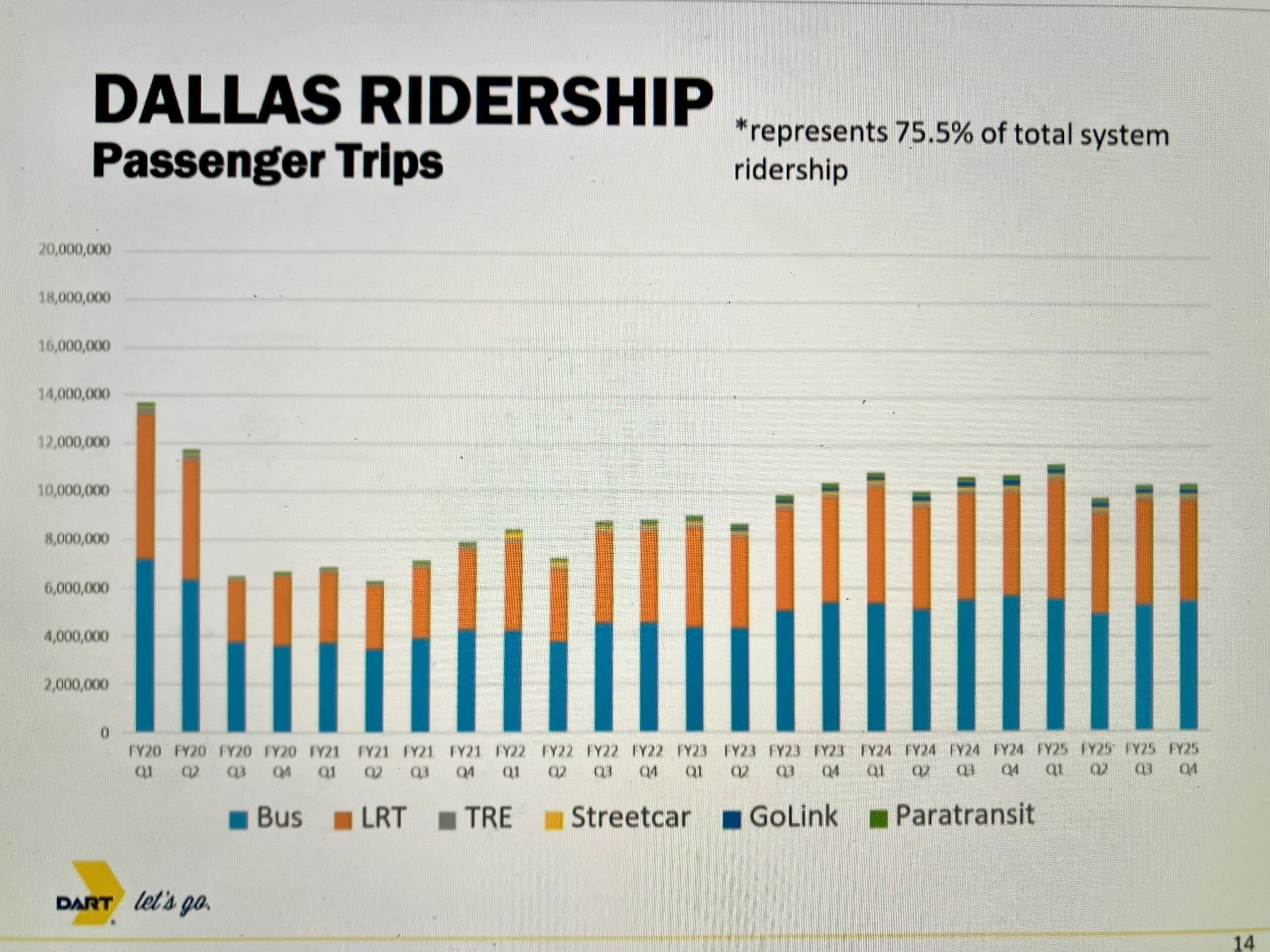
“We are seeing the growth flatten off, although we saw significant growth since 2021,” said DART Executive VP Dee Leggett during a presentation. “As you can see from this slide, Dallas represents about 75% of our total system ridership.”
Amid frustrations over DART governance and funding, four cities – Farmers Branch, Highland Park, Irving, and Plano – voted earlier this month to hold withdrawal elections on May 2, 2026, as The Dallas Express reported. The Addison City Council shot down a motion on December 2 to hold an election.
Lagging Ridership
At the beginning of 2020, DART’s total ridership was nearly 18 million, according to DART data shown in the meeting. After COVID, it dropped to less than 8 million in 2021.
DART has been slowly regaining ridership, but it has never surpassed or even come close to the pre-COVID numbers. Since then, the highest ridership was nearly 15 million in the first quarter of this year, but it has since tapered off to less than 14 million in the fourth quarter.
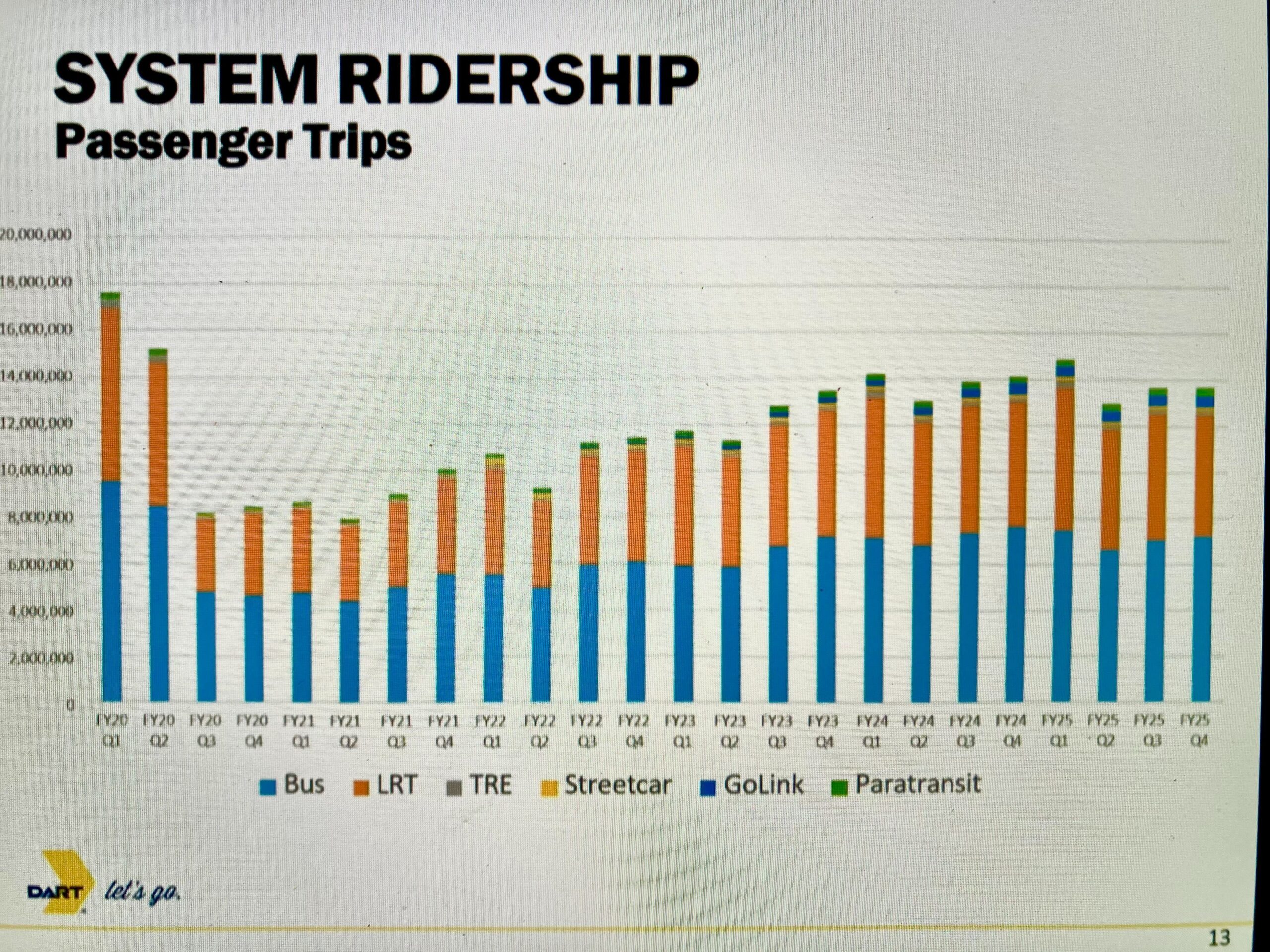
DART counts each leg of a trip as a separate rider, Irving Mayor Rick Stopfer – a member of the DART board – previously told The Dallas Express. For example, he said if 500 people took four legs of a singular trip, the agency would count them as 2,000 riders.
Dallas alone accounts for 75.5% of DART’s ridership, according to DART data shown in the meeting. In each of the agency’s member cities, the vast majority of riders had Dallas as their destination, with small numbers using the service to travel within their own city.
Councilwoman Cara Mendelsohn questioned DART officials on the system’s low ridership.
“Ridership is actually down, it’s not increasing,” she said. “When you compare Fiscal Year ‘25 quarter four with Fiscal Year ‘24 quarter four, ridership’s down, correct?”
Leggett confirmed this.
“If you do that for three quarters going back, so quarter four, quarter three, and quarter two, comparing Fiscal Year ‘25 with ‘24, all of those are down,” Mendelsohn said. “Is that correct?”
Leggett said this was “largely correct.”
“We haven’t returned to pre-COVID levels,” Mendelsohn said. “That was already nationally one of the lowest riderships of any major system in America. So I just have to ask you: if Dallas is 75% of the ridership, these suburbs must have a very minuscule amount of ridership. Is that true?”
In response, DART Board Chair Randall Bryant pointed out 75% of DART’s trips cross multiple city lines.
“I think that’s what makes the regionalism of our system most impactful, is that it’s not always inner city community,” Bryant said.
DART launched its long-anticipated Silver Line in October, connecting Plano to the Dallas-Fort Worth International Airport, as The Dallas Express reported at the time.
“We need ridership to expand. I’m just going to tell you, I’m already seeing empty Silver Line trains. That’s not the ridership. It’s not going to the places people need to go,” Mendelsohn said. “There’s something else, and I’m just going to ask you to explore what that other thing is, because we’re not getting it done.”
To increase ridership, DART has been working to reduce crime on the system and address public safety perceptions, according to Bryant.
“When we’re talking about, ‘How do we increase ridership, how do we capture that last 20% that we have not done a great job of recapturing pre-COVID?’ There are various stigmas and perceptions of the DART system and of DART crime and safety,” Bryant said.
Public Safety
Group A offenses – including arson, assault, robbery, and drug crimes – reported by DART Police have grown 2.47% this year, according to the most recent data in the National Incident-Based Reporting System (NIBRS). The increase has tapered off since earlier this year.
Within these offenses, crimes against persons fell by 22.71%, and crimes against property by 29.58%, while crimes against society increased by 50.54%.
The most common “crimes against society” were drug paraphernalia, drugs, and weapons violations.
“The data that shows increase in either crimes or responses to crimes are being shown in a negative light, as if crime is up, when the reality is we are addressing crime at higher numbers because we have more people there to respond,” Bryant said.
Three shootings took place on DART lines within weeks of each other this fall, as The Dallas Express reported.
A 53-year-old Irving restaurant manager was shot and killed near Market Center Station on September 29. A week later, a man in a “Jason Voorhees-style hockey mask” opened fire on a train, killing a 43-year-old passenger. In November, shots erupted on a DART train directly across from the agency’s headquarters downtown, wounding an adult victim.
The DART board approved $24.6 million in November for security improvements, such as system-wide cameras to catch criminals in the act, and to fund cleaning crews for bus stops and shelters, as The Dallas Express previously reported.
Mendelsohn thanked DART officials for the transparency in data.
“I do want to say especially thank you on the ridership numbers for starting with pre-COVID, so it doesn’t look all skewed. It shows the whole picture,” she said. “Again, we haven’t really seen that kind of transparency. So I want to make sure I say thank you.”