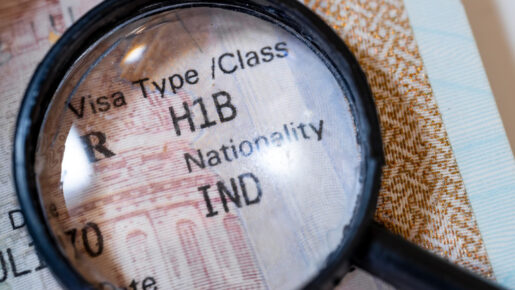
Selection rates in the H-1B visa lottery have surged past 50% as total registrations sharply decline under new federal policies.
Early results from this year’s H-1B lottery show dramatically improved odds for applicants, with multiple immigration law firms reporting selection rates “well over 50%,” a significant jump from roughly one-in-three chances in prior years, according to data shared with Bloomberg Law.
The higher success rates appear to be tied not to expanded opportunity but to a shrinking applicant pool driven by policy changes under President Donald Trump’s administration.
A $100,000 supplemental payment on new H-1B hires from abroad—introduced last year—has sharply curtailed participation. As a result, total lottery registrations are projected to fall to between 195,000 and 235,000 this year, down from more than 750,000 just three years ago and representing a decline of up to 43% from last year, according to estimates cited in the report.
“The $100,000 fee was really, it felt like, the big delta,” said Kelli Duehning, a partner at immigration law firm BAL, noting some clients saw selection rates exceed 60%.
The shift reflects a broader restructuring of the visa system. A new weighted lottery framework, finalized in December, prioritizes higher-paid and more senior workers by giving them multiple entries based on their wage level.
Observers told Bloomberg Law that while the rule changed selection mechanics, the steep drop in registrations—largely attributed to the fee—has been the dominant factor pushing selection rates higher.
“The mentality goes from maybe they’ll get selected, to expecting they’ll get selected,” said Xiao Wang, CEO of Boundless Immigration, describing the shift for applicants who remain in the pool.
At the same time, employers appear to be pulling back. The six-figure fee has “blocked almost all international recruiting” by universities and hospitals and discouraged many private-sector firms from participating, according to the report. Companies that do hire workers are increasingly focusing on candidates already in the United States.
State-level actions have compounded the contraction.
In Texas, Gov. Greg Abbott ordered a freeze on new H-1B visa petitions across state agencies and public universities in January, as previously reported by The Dallas Express. The directive requires institutions to halt new filings and undergo a review process through at least May 31, 2027, citing concerns about program abuse and alignment with federal policy changes.
That move effectively removes a significant category of public-sector demand from the H-1B pipeline within one of the country’s largest states.
Meanwhile, wage policy debates continue to add uncertainty. A recent analysis highlighted in prior DX reporting found that more than half—53.6%—of H-1B workers may already be paid below comparable U.S. workers, raising questions about whether proposed federal wage reforms will meaningfully address disparities.
The Department of Labor has proposed increasing required wage benchmarks by roughly 21% to 33%, which some analysts reportedly warn could further suppress employer participation.
Earlier reporting also noted that the $100,000 fee itself may not apply uniformly. The administration signaled potential exemptions for physicians and other roles deemed in the “national interest,” though implementation details remain unclear.
Legal challenges could ultimately reshape the landscape again. Lawsuits contesting the $100,000 fee are pending in federal courts, and rulings could determine whether the current low-registration, high-selection dynamic persists.