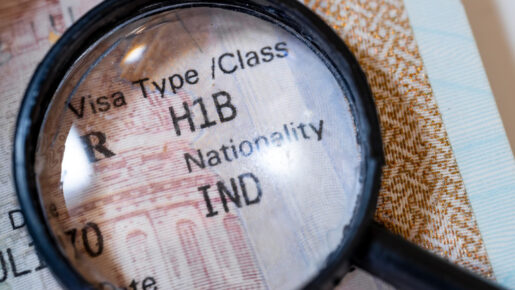
President Donald Trump moved Friday to extend for another year a restriction on entry of certain H-1B workers tied to a $100,000 employer payment, citing steep declines in registrations from major IT staffing and outsourcing firms and continued concerns about wage suppression and displacement of American workers.
The September 18 proclamation extends the policy for 12 months beginning at 12:01 a.m. EDT on September 21, 2026. It applies to certain H-1B workers outside the United States who must seek admission, while allowing the Department of Homeland Security to grant national-interest exceptions for individuals, companies or industries.
The new proclamation arrives amid unresolved litigation over the $100,000 payment requirement. A federal judge in Massachusetts vacated agency actions implementing the 2025 proclamation on June 8, and the U.S. Court of Appeals for the First Circuit denied the government’s request to stay that judgment on July 24 while the appeal proceeds. The White House proclamation does not address the litigation.
White House cites sharp shift in filings
Trump’s proclamation says the H-1B program has been “exploited to replace, not supplement, American workers with lower-paid labor,” singling out some IT staffing and outsourcing firms.
The White House said the largest IT staffing and outsourcing firms cut their combined H-1B registrations from 24,946 to 2,055 between the relevant cap seasons, a 92% decrease. It also reported a nearly 97% decrease in consular-processing requests from the fiscal year 2025 to fiscal year 2027 cap seasons.
At the same time, registrations for beneficiaries with at least a U.S. master’s degree increased from 45.1% of registrants for fiscal year 2026 to 66.1% for fiscal year 2027, according to the proclamation. Job offers corresponding to the two highest wage levels accounted for 46.3% of selections, while the lowest wage level accounted for 17.8%.
The administration attributed those changes to the $100,000 payment requirement and a separate weighted H-1B selection rule that took effect in February. The Department of Homeland Security rule gives registrations tied to higher wage levels greater weight when USCIS must select among more registrations than available cap slots.
The proclamation also said employers made the $100,000 payment for more than 700 petitions after the 2025 policy took effect.
Wage rules remain unfinished
The Department of Labor separately proposed changes in March to the prevailing-wage methodology used for H-1B and several other employment-based visa programs. The proposal would revise the four-tier wage structure to more closely align required wages with those paid to similarly employed U.S. workers.
That wage rule has not been finalized. Friday’s proclamation says the administration continues to consider additional H-1B reforms and immigration-program cost recovery.
Texas scrutiny continues
The Dallas Express has closely tracked H-1B use in Texas. Earlier this month, DX reported that 46 certified labor condition applications filed by 33 private employers requested 193 H-1B positions that named a Texas Department of Transportation worksite or recognized TxDOT address.
Gov. Greg Abbott’s January directive separately bars covered Texas state agencies and public universities from initiating or filing new H-1B petitions without written Texas Workforce Commission approval through May 31, 2027. The directive does not expressly cover private contractors that file petitions for their own employees.
Court fight remains active
The $100,000 requirement has drawn challenges from employers, universities and states. The U.S. Chamber of Commerce and Association of American Universities argue the executive branch exceeded its authority and bypassed statutory limits governing immigration fees. A federal judge in Washington, D.C., upheld the policy in that case in December 2025, and the appeal remains pending.
In the separate case brought by 20 states, the Massachusetts court reached the opposite result on the government’s implementing actions. The First Circuit’s July order declined to pause that judgment while the government appeals.
The new proclamation invokes Sections 212(f) and 215(a) of the Immigration and Nationality Act as authority for the entry restriction and directs federal agencies to continue implementing the policy consistent with applicable law.