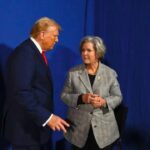


President Donald Trump called on allies to send warships to the Strait of Hormuz, promising that the crucial waterway would be made “open, safe, and free.” This statement came as Iran’s foreign minister responded by saying that Iran has no plans to back down in the region.
“Many Countries, especially those who are affected by Iran’s attempted closure of the Hormuz Strait, will be sending War Ships, in conjunction with the United States of America, to keep the Strait open and safe. We have already destroyed 100% of Iran’s Military capability, but it’s easy for them to send a drone or two, drop a mine, or deliver a close-range missile somewhere along, or in, this Waterway, no matter how badly defeated they are,” Trump wrote on March 14.
“Hopefully China, France, Japan, South Korea, the UK, and others, that are affected by this artificial constraint, will send Ships to the area so that the Hormuz Strait will no longer be a threat by a Nation that has been totally decapitated. In the meantime, the United States will be bombing the hell out of the shoreline, and continually shooting Iranian Boats and Ships out of the water,” Trump added. “In the meantime, the United States will be bombing the hell out of the shoreline, and continually shooting Iranian Boats and Ships out of the water.”
Why the Strait of Hormuz Matters
Iran’s Foreign Minister Abbas Araghchi responded with a statement, noting that the Strait “is open, but closed to our enemies, to those who carried out this cowardly aggression against us and to their allies,” per Al Jazeera.
Roughly 20% of the world’s oil and liquefied natural gas passes through the Strait of Hormuz, according to the U.S. Energy Information Administration. That energy belongs to the global economy, and its disruption would be felt from fuel depots in Fort Worth to refineries in South Korea.
Sharp Decline in Attacks: Iran’s Missiles Down 90%, Drones Down 83%
The Foreign Minister of Iran’s statement comes as their forces have continued attacking commercial shipping boats despite suffering devastating losses since Operation Epic Fury began on February 28.
As previously reported by The Dallas Express, American military officials reported that U.S. strikes had wiped out the regime’s entire “Solemani” warship fleet.
As a result of the nonstop strikes against Iran, their ballistic missile attacks have reportedly decreased by 90%, while drone attacks have decreased by 83%.
However, the United Kingdom Maritime Trade Operations still reported last Wednesday that three commercial ships in the Strait were struck by projectiles. The Thailand-flagged cargo ship Mayuree Naree was allegedly attacked, suffering an engine room fire – with Iran’s regime claiming responsibility for that strike.
In response to Iran’s ongoing use of civilian port infrastructure for military operations and attacks, CENTCOM issued a warning for civilians to evacuate Iranian ports along the Strait, putting the regime on notice that their coastal facilities in the area could lose their protected status under international law.
Shared Burden
Trump’s call for an increased naval presence in the Strait demonstrates a clear understanding of the issue at hand. No single country should bear the entire responsibility for keeping a waterway the world relies on open. The nations Trump mentioned, especially those whose economies are heavily dependent on this trade route for energy, have a direct economic interest in contributing to the effort.
The overall cost of Operation Epic Fury has not been without extreme sacrifice for America.
Since the operation began, around 140 American troops have been wounded – eight severely. According to a report from Time updated on March 13, thirteen service members in total have been killed, including six who died after an Iranian drone struck an operations center in Kuwait on March 1.