In 2025, many Americans report feeling less safe, attributing this sense of unease to persistent fears of corruption, economic instability, and violence, even if mixed with good news.
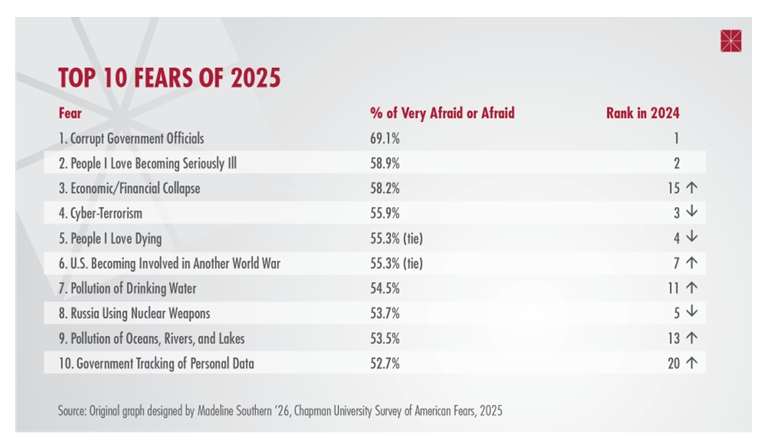
The Chapman University Survey of American Fears revealed that nearly 70% fear corrupt government officials, while over 50% worry about cyber-terrorism and U.S. involvement in another world war—trends driven more by media rhetoric than data, with homicide fears rising despite a 15% drop in murders in 2024 and further declines in early 2025, per Chapman University.
Gallup polls echoed this, showing less than 50% believe national crime is rising, the lowest since 2001, yet perceptions of insecurity persist, reported The Marshall Project.
A PBS report highlighted a stark divide: 30% of Americans now believe violence may be necessary to “get the country back on track,” up from prior years.
This unease is compounded by increased social isolation since the COVID-19 pandemic.
The American Psychological Association’s 2025 Stress in America poll found that over six in 10 adults feel stressed by societal division, with 54% reporting isolation, 50% feeling left out, and 69% needing more emotional support—up from 65% in 2024.
A Gallup poll estimates 52 million Americans still struggle with loneliness, a lingering effect of pandemic-era restrictions that eroded social fabrics, per Penn Medicine.
Globally, social isolation rose post-COVID, per a 2025 cross-sectional study, with U.S. adults particularly affected; one in four were isolated even before 2019, but rates have not fully recovered, according to JAMA via the National Library of Medicine.
Artificial intelligence has further distanced us, often substituting for human connection.
A 2025 Pew Research survey found that 50% of Americans believe AI erodes the ability to form meaningful relationships, with only 5% seeing improvement; young adults under 30 are most pessimistic at 58%.
A George Mason University study noted that those with fewer real relationships turn to AI companions, potentially deepening isolation.
Research from Organizational Psychology Review added that AI’s simulated emotions in interactions feel less genuine than human ones, reducing relational depth.
Social media amplifies fear through readily available bad news. A 2025 Nature study found negative comments on posts significantly boost anxiety (by 37%) and worsen mood compared to neutral or positive ones, especially among younger users, as reported in Scientific Reports.
Doomscrolling—endless consumption of negative content—exacerbates anxiety and depression, as noted in reports from Stanford and others, with algorithms prioritizing sensationalism, per ACP.
Nearly all therapists (99.6%) in a GrowTherapy survey agreed that watching or reading the news can negatively impact mental health.
To combat fear without denial, adopt fact-based strategies: Limit news to 15 minutes daily and turn off notifications to reduce overload.
Practice “dietary media restriction” by scheduling tech-free periods, such as mealtimes, and focusing on balanced sources. Bind anxiety through action, such as joining advocacy groups or volunteering, which builds connections and a sense of purpose. Prioritize self-care with exercise, hobbies, and outdoor time to counter isolation.
In an era where fear can feel omnipresent, reclaiming agency starts with mindful choices that prioritize connection and balance.
By fostering genuine human interactions—whether through community volunteering or tech-free social gatherings—we can counteract the isolating effects of AI and social media, building resilience against the barrage of negative news.
These evidence-based steps not only alleviate anxiety but also empower us to navigate uncertainty with hope, turning collective challenges into opportunities for stronger societal bonds.