

Addison is now the sixth city to call a withdrawal election from Dallas Area Rapid Transit (DART), with council members sending the issue to voters on May 2.
The Addison City Council approved the withdrawal election by 5-2 at a meeting on January 27, reversing course on an earlier decision to deny the vote.
As The Dallas Express reported, five other cities have already called elections – Farmers Branch, Highland Park, University Park, Irving, and Plano.
DART comprises 13 member cities.
Member city officials have become increasingly frustrated with the agency’s governance, funding, and service delivery.
Member cities have until March 18 to cancel withdrawal elections. Ahead of that deadline, DART is negotiating with officials to ease concerns and has promised no new debt before November.
If Addison voters approve the bid to leave, they will immediately “dissolve” DART in the city, but continue paying sales taxes until the city covers its portion of agency debt, according to the meeting agenda.
During the meeting, Deputy City Manager Ashley Shroyer said this would take roughly three years and cost more than $50 million.
Former Plano City Councilman Shelby Williams previously told The Dallas Express the debt provision was an “exit barrier” to keep cities from leaving.
If the withdrawal passes, DART will cut off services after the election, and Addison will advance a “mobility plan” approved by the council, according to a presentation in the meeting. If it fails, DART service will continue uninterrupted, and city officials will keep working with DART to improve governance, funding, and services.
Weighing Options
Addison officials are considering alternate transit services through Via, RideCo, Circuit, and Transdev, according to the presentation.
Shroyer said city officials sent out 300 surveys to Addison businesses on the importance of DART. The vast majority of respondents said the agency’s services were “not important,” that employees do not use it, or that changes would have “no impact.”
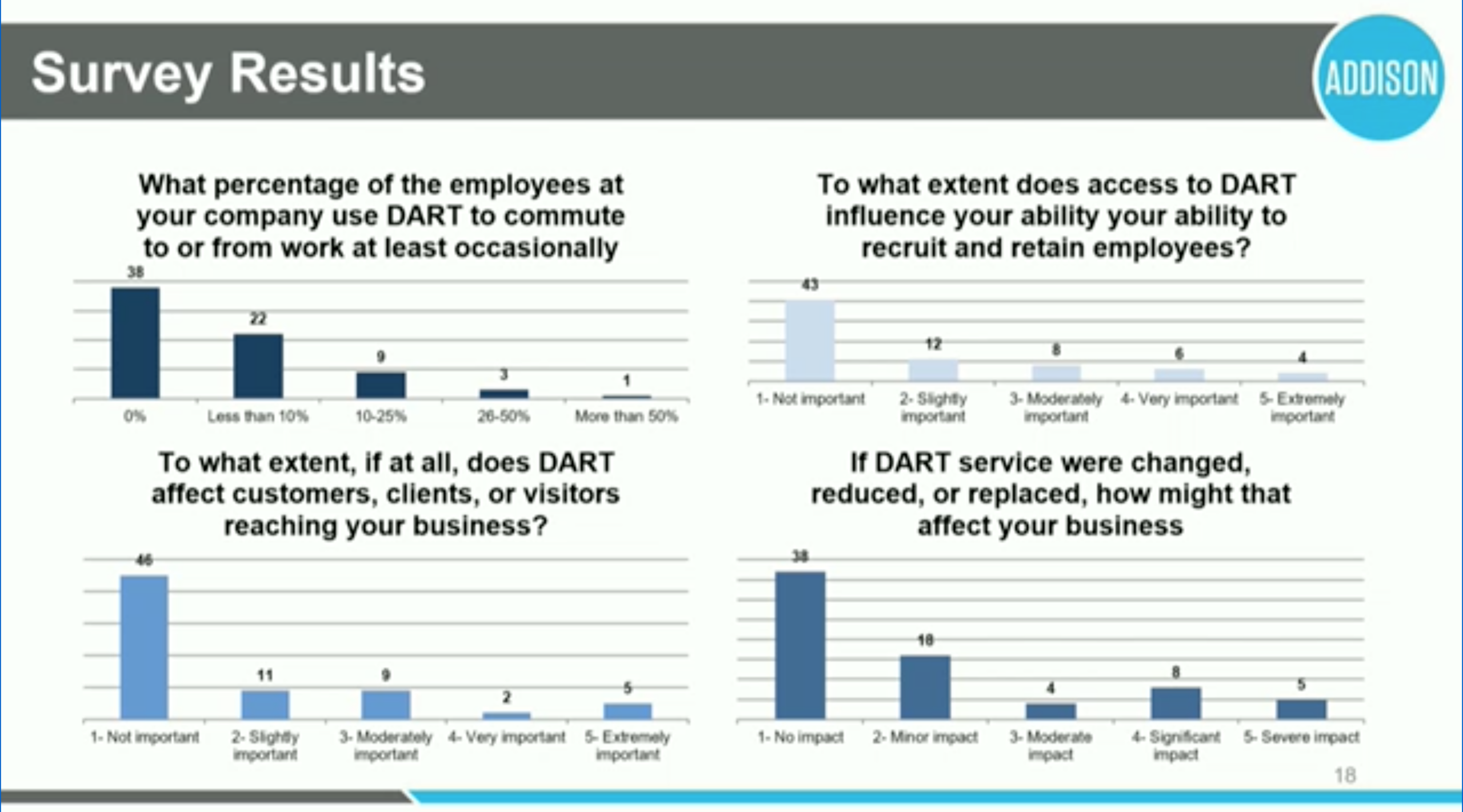
Deputy Mayor Pro Tem Chris DeFrancisco questioned the study’s methodology and asked why officials sent only 300 surveys.
Director of Economic Development Wayne Emerson said the city sent more than 300 surveys to property managers. He also said officials focused on Addison’s top 50 businesses by taxable value and employees.
“We really went for a more targeted approach to drive the response rate,” Emerson said.
DeFrancisco asked if they had questioned Bank of America, Mary Kay, or the hospital about DART, and Emerson said they had not.
“I’m disappointed that this is coming back around again,” DeFrancisco said. “I understand the frustration with DART – I understand the level of service, the way it’s funded, and I agree and understand DART is part of the problem. But given these changes, is it really smart to rush to a May election? I don’t think it is.”
Councilman Howard Freed asked Chief Financial Officer Steven Glickman about postponing the withdrawal election until November, pointing out that if the city holds the election in May, it could send $8-9 million toward paying off its share of DART’s debt.
“DART would continue to collect that local option sales tax between May and November. That would not go toward an exit obligation,” Glickman said. “If there was a May election, it would start to go to that exit obligation at that point.”
Long-Term Outcomes
Freed said his two main priorities are financial responsibility and those who depend on public transit.
“I absolutely believe in public transit. I just don’t think DART is the only answer,” he said. “These cities that have called for these elections have been negotiating with DART.”
He pointed to negotiations in Austin during the last legislative session, where DART proposed a General Mobility Program to return 5% of sales tax to certain member cities as a compromise. As The Dallas Express exclusively reported, then-Board Chair Gary Slagel wrote mayors in July, asking them to drop DART reforms in exchange for the funding.
“We were offered a 5% rebate, then it had a poison pill with it,” Freed said. “I know we’re discussing now taking that away, but the negotiations with DART from the other cities have been difficult at best.”
The GMP left DART with a $42-43 million funding shortfall, triggering the largest service cuts in history in fall 2025. The Dallas Express also exclusively reported that the agency paid executives $2.4 million in bonuses from 2020 to 2024.
Freed pointed to DART’s financial situation. While Freed said the agency has collected $15 to $16 billion in total since its inception through local sales tax revenue, he also said the agency has incurred roughly $9.7 billion in debt.
“I feel like we’ve given a blank check to DART to write whatever debt they want. We’re responsible for it,” Freed said. “From the financial standpoint, I absolutely think we should pull out of DART.”
However, Freed noted that many riders depend on the service.
“They need transit. We have to come up with a solution that keeps DART in the mix, but it may not be paying $18 million a year to DART,” Freed said. “Dozens and dozens of cities don’t have DART, and they’re doing great.”
Carrollton and Farmers Branch held elections in 1985 to withdraw from DART but ultimately failed, The Dallas Express reported. Coppell and Flower Mound successfully left the agency in 1989. Four cities voted on withdrawing again in 1996, but residents chose to stay.
Councilman Darren Gardner said officials have an obligation to educate residents, and three months should be “plenty of time.”
“The negotiation’s happening,” he said. “This is not the end, and I think we should move forward to try to make this a better option.”
Gardner said officials should secure better service and work with DART to improve governance and representation.
Currently, Dallas dominates the DART board – with suburbs like Addison, Richardson, University Park, and Highland Park all sharing a single representative, as The Dallas Express reported. Slagel represented all four cities.
Meanwhile, a 2023 study found many suburbs were paying tens of millions more to DART than they received in services, The Dallas Express exclusively reported.
For example, Addison contributed $16.3 million and received just $9.5 million in services.
Dallas contributed just $407.8 million but received $690.5 million in services.
As of December 2025, DART ridership still lagged behind pre-COVID levels, The Dallas Express also reported. Recent growth had been flattening, and Dallas accounted for 75% of ridership at that point.
Addison Mayor Bruce Arfsten supported waiting until November to hold a DART withdrawal election, citing concerns about voter education and the possibility of reduced service from other providers.
“I’m all for having the people vote,” Arfsten said. “I don’t understand the rush to May, because that is three months from now, and you’ve got to have something in place before that – something that you’ve tested and tried.”
Ultimately, the council advanced the withdrawal election. Addison voters will decide whether to remain with DART for another six years or to withdraw in favor of a local solution.