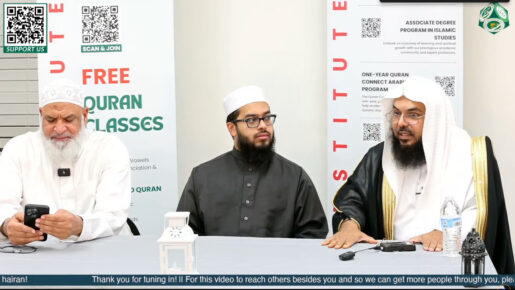


I invited Sam Westrop onto Let’s Talk Local not to fuel controversy, but to bring clarity to a complex and often emotional subject. In an era of viral videos, rapid demographic changes, and growing cultural questions, it is essential to distinguish between Islam, a major world religion practiced by millions of Americans, and Islamism, a political ideology that seeks to advance Islamic law (Sharia) and supremacy through institutions, funding networks, and influence in public life.
Sam Westrop, director of Islamist Watch at the Middle East Forum, provided a measured and evidence-based framework for that distinction. His analysis helps us move beyond slogans toward informed understanding.
Texas is home to a large and ever-growing Muslim community. Estimates suggest roughly 330 mosques statewide, with approximately 67 in the Dallas–Fort Worth metroplex (around 62 Sunni and 5 Shia). The real question is whether specific networks are using Western institutions and resources to promote ideologies incompatible with American constitutional values.
Sam emphasized that conflating the religion with the ideology is both analytically imprecise and strategically unhelpful. It risks alienating Muslim reformers who oppose extremism and obscures our ability to focus on documented networks and funding streams. During the episode, we reviewed several viral clips depicting troubling rhetoric and instances of abuse. Sam did not dismiss these examples. Instead, he encouraged careful analysis when I asked: Who produced the content? What ideology underpins it? Is this reflective of a broader organized effort or isolated behavior? Is this present in Texas, and if not, when might it be?
He also addressed the financial dimension of Islamist influence. While Texas has no traditional full-service Sharia-compliant banks, it does host multiple providers of Sharia-compliant financing products. Approximately 15 such institutions operate within the state, particularly for home mortgages, auto loans, and business purposes. Providers such as Guidance Residential, UIF Corporation (which recently merged operations with LARIBA), Devon Islamic Finance, and others operate in Texas markets including Dallas, Houston, and Richardson. Some providers also offer Sharia-compliant products in Texas.
These instruments avoid conventional interest (riba) and are structured according to Islamic financial principles. On one level, they serve the legitimate needs of observant Muslims seeking faith-consistent options. At the same time, Sam pointed out that such financial mechanisms can form part of larger funding ecosystems. Islamist networks often rely on charitable giving, investment vehicles, and institutional partnerships that warrant closer scrutiny, especially when public funds or tax-exempt status are involved.
For many Christians in Texas, this conversation extends beyond politics and demographics; for many believers, it carries spiritual weight. I have found Pastor Josh Howerton’s teachings at Lakepointe Church particularly helpful. His recent clips provide thoughtful biblical context:
Howerton examines the profound differences between Christian and Islamic eschatology, including themes of martyrdom and the Mahdi, which help explain why many Christians approach this subject with heightened concern.
View this post on Instagram
Drawing from 2 Thessalonians, he discusses the idea of a “powerful delusion,” a spiritual blindness that can prevent people from recognizing clear contradictions in ideology and culture.
View this post on Instagram
He also addresses the unlikely alliances that sometimes form between secular progressivism and Islamist objectives, alliances that become more understandable when theological foundations are set aside. These reflections are not presented as direct proof of specific Texas developments, but as a framework for why many people of Christian faith often see this issue as more than a policy debate.
Sam concluded with actionable recommendations rather than vague warnings. He outlined a straightforward approach often summarized as the “Three D’s”:
- Defund: Halt public and private resources flowing to networks with documented extremist ties.
- Designate: Use existing legal tools to identify and constrain extremist organizations and individuals.
- Disrupt: Strengthen enforcement, oversight, and due diligence across institutions.
He stressed that churches, charities, and nonprofits bear a particular responsibility to exercise careful vetting when forming partnerships. Reasonable intent must be paired with prudent accountability. Following Sam’s recommendation that citizens contact lawmakers, I drafted the sample letter below:
If you want to contact your representatives, you can enter your address at the link below to identify your federal and state lawmakers:
https://wrm.capitol.texas.gov/home
Dear Texas state legislator:
Dear member of the U.S. Congress:Sam Westrop, director of Islamist Watch at the Middle East Forum, has published research reporting that roughly $1 billion in federal and Texas taxpayer funds has gone to organizations he identifies as Islamist-linked. His work also identifies six major Islamist networks that he says influence a significant portion of Islamic nonprofits across the state.
We implore you to:
- Conduct thorough investigations into Islamist networks operating in the state.
- Audit and redirect public funding away from organizations with documented extremist connections.
- Enhance transparency and oversight for mosques, charities, schools, and financial institutions that receive taxpayer support or operate with limited accountability.
- Actively support moderate Muslim voices and reformers who reject Islamism.
- Enforce existing laws with consistency and vigor, ensuring that ideological influence does not erode constitutional principles.
This letter is not about targeting people of faith. It is about safeguarding the core Texas values of liberty, equality under the law, and religious freedom for all.
My conversation with Sam Westrop was never intended to promote fear. It was an exercise in discernment. We must reject both uncritical multiculturalism that overlooks genuine concerns and indiscriminate suspicion that fails to differentiate between individuals and ideologies. True clarity requires precision: separating a religion from a political project, demanding transparency in funding and influence, and responding with wisdom, courage, and respect for the rule of law. I invite you to listen to the full episode HERE and consider how we, as Texans, can uphold our principles while remaining vigilant.