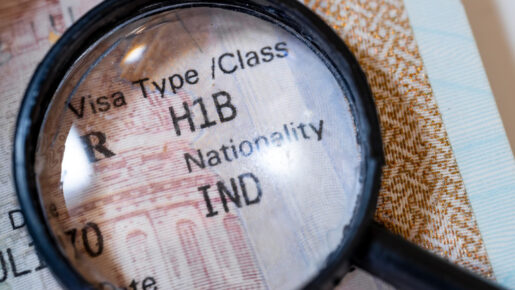
Top executives warn that restricting foreign talent could undermine U.S. innovation, even as Vice President J.D. Vance highlighted a sharp decline in H-1B visas and renewed calls to eliminate the program.
Speaking at a policy gathering in Washington on April 16, biotech entrepreneur Noubar Afeyan argued that limiting access to global talent threatens what he described as the country’s economic “regenerative capacity.” Afeyan, a cofounder of Moderna and head of Flagship Pioneering, said the United States has historically benefited from immigration-driven innovation.
“If we mess with that, we lose our regenerative capacity,” Afeyan said, adding that the nation’s economic strength has been shaped by generations of immigrants, according to remarks delivered at a Semafor event.
Executives in the technology sector echoed similar concerns. Gary Cohn, vice chairman of IBM, said the company remains “highly dependent” on foreign workers and continues to use the H-1B visa system. While cautioning against misuse of the program for lower-skilled roles, Cohn said visas for workers who “create GDP” and economic growth represent “a phenomenally good use.”
These views contrast with Vance’s recent statements and the Trump administration’s policy direction.
Vance said on April 14 at a Turning Point USA event in Georgia that new H-1B visa issuance has dropped by roughly 90% since President Donald Trump returned to office, attributing the decline to administrative changes. He described the reduction as a deliberate effort to curb what he and other critics view as overreliance on foreign labor, according to Newsweek.
The administration’s changes include a $100,000 supplementary payment for certain applications, a rule to increase wages for H-1B workers, and a shift toward prioritizing higher-paying roles, as previously reported by The Dallas Express.
Vance has also pushed for more sweeping reforms. Speaking to college students, he urged them to question political candidates about their stance on the visa system and reiterated his support for eliminating it altogether.
“When you guys graduate from this university, I don’t want you competing against a low-wage foreigner for your first job,” Vance said, per NewsMax. “I want a company to have to pay you a fair wage for a fair day’s work.”
Wages are at the center of the political debate over the H-1B visa.
“H‑1B workers are highly paid: their wages are in the 90th percentile of all wages in the United States, meaning that they have wages in the top 10 percent of U.S. wage earners,” according to a 2023 CATO Institute report.
Yet, a 2026 study found that H-1B workers are paid 16% less than comparable U.S.-born workers after adjusting for key factors.
Vance’s message to American students is particularly relevant as the profile of applicants for an H-1B visa has shifted in recent months. Employers of foreign graduates from U.S. universities with Optional Practical Training work authorization are largely exempt from the $100,000 H-1B supplmentary payment when it comes time for these workers to transition between legal statuses.
Therefore, even though cap-subject registrations have plummeted by roughly a quarter between fiscal year 2025 and 2026, from 470,342 to 343,981 eligible registrations, there is still a surplus of H-1B workers available to U.S. employers, and this excess is increasingly favoring young foreigners graduating from U.S. colleges.
This has led some, including former Trump White House Senior Counselor Steve Bannon, to criticize Vance’s claim of a 90% reduction in H-1B visa issuance, calling it misleading, even as the duo appears to agree that there should be fewer H-1B visas.
BANNON: The @VP either doesn’t understand the math or he’s giving misinfo. H-1Bs are a crisis. We’re letting too many foreign workers take jobs from American citizens.
America First and American citizens above that. American citizens first. They get the best deal. The foreign… https://t.co/oRkWjxjwLR pic.twitter.com/L8Niy1a41N
— Grace Chong, MBI (@gc22gc) April 17, 2026
The debate reflects broader tensions within the business community and policymakers over how to balance economic growth with domestic labor protections.
Previous reporting by The Dallas Express highlighted how major corporations rely heavily on foreign workers. IBM is reported to be headed by a former H-1B visa worker and employed at least 15,000 of these workers between fiscal years 2020 and 2025, according to federal data cited in the report.
That report detailed a $17 million settlement between IBM and the Department of Justice over allegations tied to diversity policies.
At the same time, enforcement of the visa system has intensified. Federal investigations of H-1B employers are reported to be up 48% as the Department of Labor executes “Project Firewall,” a Trump administration initiative targeting fraud, wage violations, and failures to recruit U.S. workers.