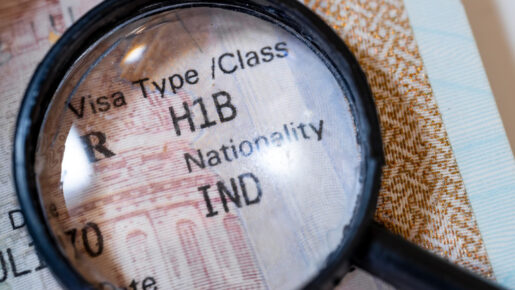


A new economic paper series argues that the H-1B visa program enables companies to pay highly skilled foreign workers significantly less than their American counterparts. The paper further suggests that this could justify imposing six-figure visa fees without diminishing demand for these workers.
The working paper, released by the National Bureau of Economic Research and authored by Harvard economist George J. Borjas, finds that H-1B workers earn approximately 16% less than comparable U.S.-born workers, after adjusting for education, age, gender, occupation, and geography.
“On average, H-1B workers earn 16 percent less than comparable natives,” per the paper.
The study merges federal Labor Condition Application records, I-129 petitions, and American Community Survey data from 2021 through 2024. It estimates that, because the average H-1B salary exceeds $100,000, the pay differential yields payroll savings of nearly $100,000 over the typical six-year visa term.
“The evidence unequivocally documents the existence of a substantial wage gap between H-1B workers and comparable Americans,” Borjas writes.
The findings come as President Donald Trump’s administration has directed changes to the program, including a proposed shift from the former lottery system—which allocates 85,000 new visas annually to for-profit employers—to a wage-weighted selection process.
Between 2021 and 2026, about 450,000 workers entered the lottery each year for those 85,000 slots, according to federal data cited in the paper.
Borjas argues that because demand so far exceeds supply, employers may be willing to pay substantial upfront fees.
“The revenue-maximizing fee is between $118,000 and $264,000, has little or no impact on the number of H-1Bs hired, and generates between $6.2 and $22.4 billion in revenues,” the paper states.
The model assumes an annual job separation rate of 9.4% among H-1B workers.
The paper also finds sharp differences across firms and occupations. The adjusted log wage gap is reportedly small at some technology giants, including Meta Platforms (-0.011, approximately -1.1%), but substantially larger at outsourcing firms such as Tech Mahindra Americas (-0.348, approximately -34.8%). Within occupations, the adjusted log wage gap is -0.298 (approximately -29.8%) for software developers.
Notably, the wage gap widens among higher-skilled workers.
“The table reveals that the H-1B workers at the top of the skill distribution have the lowest earnings relative to their native counterparts. There is no wage gap disadvantage in the bottom quartile of the distribution, but this gap increases to -11.8 percent for workers in the third quartile, and to -28.6 percent for workers in the top quartile,” per the study.
Dallas ranks second nationally in concentration of capped H-1B workers, accounting for 9.2% of all such visa holders between 2021 and 2024, according to the paper. By contrast, only 2.6% of comparable native workers reside in the metro area. This clustering suggests that the program’s wage and hiring effects may be disproportionately concentrated in North Texas, particularly in software and technology-related fields, where H-1B employment is heavily concentrated.
The National Bureau of Economic Research (NBER) is a private, nonprofit research organization that distributes working papers by economists. Its working papers are preliminary studies that have not necessarily undergone formal peer review but often influence academic and policy debates.
Borjas writes that the analysis “[examined] the implications of the gap for policy changes… that can be adopted to redistribute the payroll savings now enjoyed by lottery-winning firms,” as lawmakers and federal agencies continue to debate the program’s future.
While this study focused on the private sector, many public-sector employers in Texas also employ H-1B visa holders. Dallas ISD has employed 1,272 H-1B visa workers over the past five years, according to the U.S. Citizenship and Immigration Services H-1B Employer Data Hub.
The district allocated 2.5 million in federal taxpayer funds to an immigration law firm operating under a minority- and women-owned business enterprise designation to process many of these positions, The Dallas Express previously reported.