

What happens when you give young people a platform and then let them help decide what that platform should become? That’s the experiment behind the next evolution of Future Voices at The Dallas Express.
What began as a column giving young writers a place to share their ideas is now being piloted as something broader: a Future Voices Incubator at The Dallas Express where the next generation can learn how ideas become stories, stories become media, and media can become something people actually want to watch, read and share.
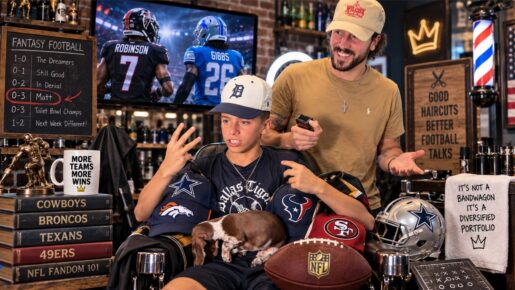
Sometimes that means writing an article. Sometimes it means sitting across from an adult and asking better questions. Sometimes it could mean building a business concept, creating with AI or producing a documentary. And apparently, sometimes it means arguing about fantasy football while getting a haircut! Welcome to Barber Ball Banter: A Future Voices Incubator Pilot.
The idea wasn’t dreamed up in a production meeting. In fact, nobody initially intended to create a show. Thirteen-year-old Louis Darrouzet has been getting his hair cut by Matthew “Matt” or “Mattie” Steigerwald for roughly four years. Matt is a veteran, barber and entrepreneur behind Dallas-based Mattie’s Parlour, where he has built a loyal clientele and earned a perfect 5-star reputation on Booksy.
But Louis doesn’t spend his time in Matt’s chair quietly waiting for a haircut. They talk sports. Constantly. Fantasy lineups. Players. NFL predictions. College football. The Dallas Cowboys. Who should start. Who should sit. Who’s overrated? And who’s wrong.
The conversations have been happening for years. Future Voices simply asked a different question: What happens if we turn the camera on?
The kid became part of the production team
That’s where the experiment became considerably more interesting. Louis wasn’t simply asked to appear on camera. He was asked to help review the footage and help build the platform. Two initial clips had already been selected from the conversation. Louis watched them and immediately identified what was missing.
Viewers didn’t really know who Matt was. They didn’t know the history between them. They hadn’t heard which teams they supported. And the clips were too long. “If it’s more than a minute, it gets really boring,” Louis said while reviewing the footage.
His point wasn’t that every piece of content must fit an arbitrary time limit. His point was that his generation expects content to earn its attention quickly. If something is compelling, he’ll stay. If it isn’t, he’s gone. Then came his second piece of production advice: “You need tension.”
Louis wanted future episodes to capture moments when he and Matt actually disagree over a fantasy pick, a team, a player or a prediction. In other words, the 13-year-old wasn’t merely appearing in the content. He was beginning to understand how to build it. And that’s precisely the kind of learning Future Voices is being expanded to explore.
Meet Matt: veteran, barber and entrepreneur
Louis also happens to have an interesting person standing on the other side of the chair. Matthew Steigerwald is a veteran who became a barber and is now building as an entrepreneur. His shop, Mattie’s Parlour, has developed an exceptional reputation among customers, with a perfect 5-star rating on Booksy and reviews praising not simply his work, but the experience and conversation in his chair. That last part matters.
Because the relationship between Matt and Louis wasn’t manufactured for a camera. It already existed. Matt has watched Louis grow up in his chair. They already know how to talk to one another. They already know how to disagree. And Matt brings something else to Future Voices that matters: adult experience without replacing the young person’s voice. When the conversation turns from football into leadership, for example, Matt draws from lessons he learned through military service.
Louis listens. Then he pushes back, adds his own perspective and relates it to what he sees on the field. That’s mentorship without a lecture.
Fantasy football becomes the classroom
Ask Louis to explain fantasy football and you’ll quickly discover he’s doing more than picking favorite players. He understands the numbers. While reviewing his own matchup, he walked through how yards, receptions and touchdowns translate into points; how projections work; how individual performances combine to determine a weekly winner; and why a projected 63% chance of losing doesn’t necessarily mean the matchup is over.
Then he looked at his own team. “I don’t really stand a chance.” Matt disagreed.
Suddenly they’re comparing players, examining matchups and debating where Louis might have an advantage. And underneath the sports conversation, something else is happening. Louis is analyzing data. He’s defending an argument. He’s communicating it. He’s listening to a competing opinion. And he’s deciding whether the evidence changes his mind. Nobody told him he was learning.
And then there are the Cowboys
If Barber Ball Banter ever needs the “tension” Louis requested, the Dallas Cowboys should provide plenty. Matt believes the Cowboys have talent. His frustration centers partly on leadership, something he connects to lessons from his military experience. Louis approaches the same problem differently. He talks about utilizing players’ individual strengths and having a coach capable of bringing those talents together.
They’re separated by decades of life experience. Yet within minutes they’re wrestling with essentially the same question: Why can a group of talented people still fail as a team? That’s where Barber Ball Banter becomes more than a sports clip. And it’s where the broader Future Voices experiment gets interesting.
From Future Voices column to Future Voices Incubator
The original premise of Future Voices was simple: Young people have something worth saying, and faith should be its foundational guiding post. That isn’t changing. The pilot asks what happens when we go further. What if young people also learn how to communicate those ideas across different mediums?
What if they learn how to interview someone? Edit a video? Recognize a hook? Analyze an audience? Build a brand? Use AI truthfully and alongside humanity? Understand a business model? Work alongside entrepreneurs and professionals? And, importantly, what if adults stop assuming they already know the best way to reach the next generation and occasionally ask the next generation instead?
Louis’s assessment of the first Barber Ball Banter footage is a pretty good example. The adults had clips. The 13-year-old had notes. But Barber Ball Banter isn’t meant to define Future Voices. It’s simply one expression of what Future Voices could become. In fact, we’re piloting another very different expression this same week.
Thirteen-year-old Joseph Rockett’s Future Voices apologetics piece begins with questions about science, faith and what happens when something you’re taught seems to conflict with something you believe. Instead of simply declaring what he believes, Joseph explores apologetics and the importance of learning how to ask questions and articulate why he believes it. Joseph starts with the written word. Louis starts in a barber chair.
That’s the point. The subject matter doesn’t have to be the same. The medium doesn’t have to be the same. Even the final product doesn’t have to be the same. The common denominator is the young person.
What else could they build?
That’s where the possibilities become exciting. Another young person could interview a CEO by researching the company, learning the business and sitting across from someone with decades more experience to ask thoughtful questions.
Someone else could develop a business concept, build the model and document what happens when an idea meets the real world. A student interested in filmmaking could produce a short documentary.
A teenager fascinated by technology could develop an AI project, learning not simply how to use artificial intelligence, but how to use it responsibly, truthfully and alongside human judgment and creativity.
Two young people with different perspectives could learn how to have an actual debate by making an argument, defending it with evidence, listening to the other side and discovering that disagreement doesn’t require contempt.
A person passionate about style could launch a fashion blog. Someone who loves design and craftsmanship could create a sewing series, taking an audience from inspiration and sketch to pattern, construction and finished piece.
A competitive cheerleader could create a cheerleading documentary, taking viewers beyond the bows and uniforms to the training, athleticism, teamwork, injuries, pressure, discipline and perseverance that most spectators never see. And someone else may walk through the door tomorrow with an idea none of the adults involved ever considered. That’s precisely what should happen. Future Voices doesn’t need to tell young people what their voices are supposed to sound like. It can give them the tools, mentorship and platform to discover what they want to say and how they want to say it.
Every Wednesday creates another experiment
For Louis and Matt, fantasy football gives Barber Ball Banter a particularly useful recurring structure. Every Wednesday, lineups need attention.
Matt and Louis make predictions. Then they come back the following week and face the receipts. Roll last week’s tape. Who was right? Who was completely wrong? Who ignored an injury? Who started the wrong player? Who talked the most trash? Then Matt turns the clippers back on and they do it again. New week. New lineup. New haircut. New argument.
Maybe that’s what Future Voices should be
The most interesting part of Barber Ball Banter may not ultimately be football. It may be what happens when a 13-year-old is treated not simply as a subject in a story, but as someone capable of helping create one. Matt brings years of life experience, military service, craftsmanship and entrepreneurship into the chair.
Louis brings baseball, fantasy football, curiosity, a teenager’s perspective and apparently some fairly strong opinions about audience retention. Joseph brings questions about science, faith and learning how to articulate why he believes what he believes. Different young people. Different interests. Different mediums. One underlying idea: their voices are worth developing. They can learn from adults, and adults can learn from them. And sometimes the camera simply lets the rest of us watch it happen.
That’s the next experiment for Future Voices at The Dallas Express. The column gave young people somewhere to write. The Future Voices Incubator asks what else they might build once they’ve written well for long enough.
And in one Dallas barber chair, one answer starts with a veteran-turned-entrepreneur, a 13-year-old baseball player, a haircut and a disagreement waiting to happen. Welcome to Barber Ball Banter: A Future Voices Incubator Pilot.
If you want to submit an article to this column, please follow the attached document.
Email [email protected] with any questions.
Future_Voices_Contributor_Guide_2025.
About Future Voices
Future Voices is a Sunday-morning column in The Dallas Express in which young Texans share how faith and perseverance shape their lives. These stories remind readers that God often speaks through the honesty and courage of the next generation.