A new court filing is intensifying the legal battle over President Donald Trump’s $100,000 H-1B payment requirement as business groups and immigration restriction advocates clash over executive authority and the future of high-skilled immigration.
The Federation for American Immigration Reform (FAIR) filed an amicus brief on February 5 in the U.S. Court of Appeals for the District of Columbia Circuit, backing the Trump administration in Chamber of Commerce v. DHS and urging the court to uphold Proclamation 10973.
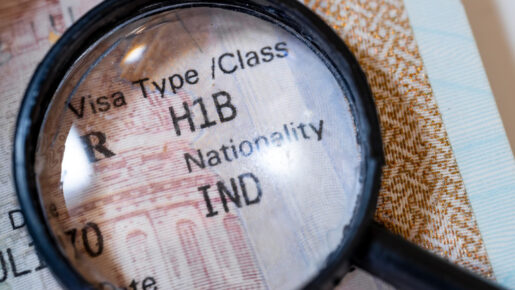
The proclamation, issued in September 2025, restricts entry for certain new H-1B nonimmigrant workers unless their petitions are accompanied by a $100,000 payment, as previously reported by The Dallas Express. A White House fact sheet framed the action as a step to “curb abuses that displace U.S. workers and undermine national security,” at the time of the order.
In its brief, FAIR argued that “The President is not subject to the [Administrative Procedure Act], nor are his actions here otherwise reviewable,” contending that courts lack authority to second-guess presidential immigration decisions made under 8 U.S.C. § 1182(f). “The APA applies only to agencies,” the attorneys wrote. “The President, though, is not an agency, and thus the APA does not apply to him or his actions.”
FAIR further asserted that “Courts cannot review this exercise of Presidential discretion,” adding that “Decisions about whether to exclude aliens or place preconditions on their entry are, fundamentally, foreign policy decisions.”
Even if the court were to review the proclamation, FAIR argued it would still survive because it conditions entry rather than imposing a statutory fee. “The H-1B visa is detrimental to American workers because its terms permit replacing Americans with H-1B workers,” the brief states. “The available data clearly support such a finding.”
The organization described the $100,000 charge as “eminently reasonable,” writing, “The obvious way to separate the wheat from the chaff flowing into the labor market is to impose a fee.”
Business groups challenging the policy have framed the issue differently.
In an October 24, 2025 memorandum supporting their motion for a preliminary injunction, lawyers for the Chamber of Commerce and the Association of American Universities argued that “The Proclamation exceeds the President’s authority” and “conflicts with express provisions of the INA.”
They contend that Congress already established a detailed H-1B framework, including specific fee amounts, and that the proclamation “improperly attempts to supplant other provisions of the statute governing the H-1B program.”
The Chamber lawyers have also argued in court that “By congressional design, employers need not show that their prospective [H-1B] workers are the best of the best, but merely highly skilled,” and criticized the proclamation for attempting to transform the program into one that admits only “the best of the best” based on an employer’s ability to pay.
That language contrasts with the Chamber’s public advocacy.
On its website in October 2025, the organization said that U.S. global leadership is powered by “attracting the best talent from around the world” and emphasized the importance of “retaining the best and brightest.” In court, however, the Chamber has stressed that the statutory H-1B standard is broader and does not require employers to prove a worker is elite.
A coalition of 21 states and the District of Columbia filed a separate amicus brief in January arguing that “The H-1B program has been a lifeline for hospitals, public schools, and universities” and warning that “If the fee is allowed to remain in effect, Amici States and their residents will suffer.”
The Consumer Technology Association also filed a brief in January arguing that there is “not a word” in the immigration statute authorizing the president to impose a $100,000 charge, and warning that interpreting the law to allow such a charge would raise serious constitutional concerns under the Supreme Court’s 2025 nondelegation decision in FCC v. Consumers’ Research.
The administration has maintained that the proclamation “readily satisfies the statutory prerequisites” of Section 1182(f) and that the payment requirement functions as a lawful restriction on entry rather than a statutory fee.
Oral arguments in the appeal are expected in the coming months. The outcome could have implications not only for the H-1B program, but also for the scope of presidential authority over immigration policy.