President Donald Trump said Saturday that executive actions and pardons signed using an autopen during former President Joe Biden’s administration are illegal and called for those involved to be arrested, echoing concerns also raised in a House Oversight Committee investigation about documentation and authorization.
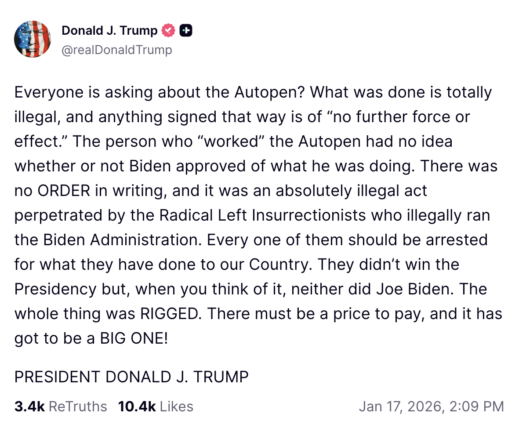
President Donald Trump posts on Truth Social on January 17, 2026, calling autopen-signed actions under the Biden administration illegal and urging arrests | via Truth Social
In a January 17 post on Truth Social, Trump said the use of the autopen was “totally illegal” and that documents signed that way are of “no further force or effect.” Trump asserted that the individual who operated the autopen “had no idea whether or not Biden approved of what he was doing,” adding that there was “no ORDER in writing.”
Trump went further, writing, “Every one of them should be arrested for what they have done to our Country.”
Trump’s comments follow the October 28, 2025 release of a staff report by the House Committee on Oversight and Government Reform, led by Chairman James Comer (R-Ky.). Titled “The Biden Autopen Presidency: Decline, Delusion, and Deception in the White House,” the report alleges that senior White House aides facilitated executive actions — including pardons and commutations — without clear, contemporaneous documentation demonstrating Biden’s direct authorization.
According to the report, investigators identified gaps in recordkeeping, unclear chains of custody for decision materials, and instances in which approval for autopen use was conveyed verbally or second-hand. The committee recommended that the U.S. Department of Justice review executive actions taken between January 2021 and January 2025, with particular scrutiny of clemency actions signed by autopen.
Prior reporting on autopen authorization
The Dallas Express previously reported in July 2025 that autopen use for late-term Biden pardons, including the preemptive pardon of Dr. Anthony Fauci, was approved by then–White House Chief of Staff Jeff Zients rather than documented directly by Biden.
At the time, reporting showed Zients sent an email on January 19, 2025 stating, “I approve the use of the autopen for the execution of all of the following pardons,” after aides prepared summaries of oral discussions allegedly held with Biden. The aides who drafted the materials authorizing the pardons were not present in the room with Biden, according to meeting participant lists reviewed by The New York Times.
Biden denied that staff acted without his consent. In an interview with The New York Times, Biden said, “I made every single one of those,” referring to the pardons and commutations issued at the end of his term, adding that the autopen was used for efficiency because “we’re talking about a whole lot of people.”
The Oversight Committee’s report builds on those disclosures, citing testimony from aides who could not confirm direct presidential authorization in certain cases and identifying missing or incomplete documentation tied to autopen-signed actions.
Opposition arguments over autopen legality
Critics of Trump’s position argue that the use of an autopen does not, by itself, invalidate presidential pardons or executive actions.
Legal scholars cited by PolitiFact contend that the U.S. Constitution does not require a president to personally hand-sign pardons and does not prohibit the use of mechanical signing devices. They also argue that once a pardon is completed, there is no established constitutional mechanism for a subsequent president to revoke it.
Biden has echoed that view, maintaining that he personally authorized the actions and that autopen use was carried out at his direction.
The Oversight Committee report does not dispute that autopens may be used under certain circumstances. Instead, it centers on whether presidential authorization was properly documented and whether executive authority was exercised by aides without verifiable consent from the president.
What happens next
Trump has said his administration will review actions signed by autopen during Biden’s presidency. Legal experts cited by PolitiFact argue that any attempt to invalidate completed pardons would require formal legal proceedings and would likely face immediate court challenges.
The Department of Justice has not publicly stated whether it will act on the Oversight Committee’s referral. No court has ruled on the validity of the executive actions cited in the report.
As of now, Trump’s statements — including his call for arrests — the Oversight Committee’s findings, and opposition arguments from constitutional scholars remain unresolved, setting the stage for potential legal scrutiny over presidential authority, documentation standards, and the limits of autopen use.