

Defense Secretary Pete Hegseth described the ongoing U.S.-Israeli military strikes against Iran as “laser-focused” on Monday, emphasizing the mission to dismantle Tehran’s missile capabilities, navy, and security assets to block any nuclear ambitions, while insisting the effort would not drag on indefinitely.
“Destroy Iranian missiles, destroy Iranian missile production, destroy their navy and other security infrastructure, and they will never have nuclear weapons,” Hegseth said at a Pentagon briefing alongside Joint Chiefs Chairman Gen. Dan Caine.
He offered no specific end date but stressed, “This is not Iraq. This is not endless. I was there for both — our generation knows better, and so does this president. He called the last 20 years of nation-building wars dumb, and he’s right. This is the opposite. This operation is a clear, devastating, decisive mission: Destroy the missile threat, destroy the navy, no nukes.”
Hegseth ruled out current U.S. ground forces in Iran, adding he would not “go into the exercise of what we will or will not do” moving forward. He framed the strikes as a response to Iran’s actions, accusing the regime of initiating hostilities through its “stubborn and self-evident nuclear pursuit” and “targeting global shipping lines.”
“Iran had a conventional gun to our head as they tried to lie their way to a nuclear bomb,” he said. “Iran was building powerful missiles and drones to create a conventional shield for their nuclear blackmail ambitions.”
For 47 years, Hegseth claimed, Iran has “waged a savage, one-sided war against America.” He added, “Their war on Americans has become our retribution against their ayatollah and his death cult.”
Hegseth denied the operation aimed at regime change, despite the killing of Supreme Leader Ayatollah Ali Khamenei in strikes on his Tehran compound, saying: “This is not a so-called regime change war, but the regime sure did change and the world is better off for it.”
Hegseth cited last summer’s U.S.-Israeli attacks that “obliterated their nuclear program to rubble” and accused Iranian officials of “stalling” in pre-strike talks.“The former regime had every chance to make a peaceful and sensible deal. But Tehran was not negotiating,” he added.
Hegseth outlined a no-holds-barred approach: “No stupid rules of engagement, no nation-building quagmire, no democracy building exercise, no politically correct wars. We fight to win, and we don’t waste time or lives.”
The briefing, the administration’s first since the weekend assault, followed President Donald Trump’s Sunday statement that the joint effort would persist “until all of our objectives are achieved,” potentially lasting “four weeks or less,” with possible additional U.S. deaths.
Trump, in a New York Times interview, estimated “four to five weeks.”
Hegseth downplayed timeline queries: “President Trump has all the latitude in the world to talk about how long it may or may not take. Four weeks, two weeks, six weeks. It could move up. It could move back.”
Caine detailed the launch, noting that Trump authorized “Operation Epic Fury” at 3:38 p.m. EST Friday aboard Air Force One en route to Texas. Preparations included readying air defenses, conducting final rehearsals, loading weapons, and positioning strike groups as the Pentagon and Tampa command centers were activated.
The assault began at 9:45 a.m. local time (1:15 a.m. ET) with over 100 aircraft from land and sea, plus unmanned platforms in a “single synchronized wave.” Navy Tomahawks struck first, targeting Iranian naval forces along the southern flank.
“This was a daylight strike based on their trigger event conducted by the threat, the defense forces, enabled by the U.S intelligence community,” Caine said.
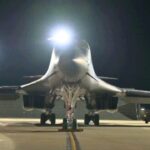
B-2 stealth bombers flew 37-hour round trips, echoing last year’s nuclear site strikes. Cyber tools “effectively disrupted communications and sensor networks,” delivering “synchronized and layered effects designed to disrupt, degrade, deny, and destroy Iran’s ability to conduct and sustain combat operations on the U.S. side.”
Hundreds of targets hit include missile sites, navy headquarters, and warships.
Entering its third day, the conflict has widened. Iran and proxies fired missiles at Israel, Arab nations, and U.S. bases. A fourth U.S. service member died Monday, all four from a strike on a tactical command center.
Caine noted that “We expected to take additional losses.”
In Kuwait, allied forces downed three U.S. F-15E Strike Eagles in a “friendly fire incident” amid Iranian attacks; all six pilots ejected safely and are stable. Smoke rose from the U.S. Embassy there after an apparent Iranian missile hit.
Caine said battle damage assessments would take time and would inform future targeting.
Reported deaths include 555 in Iran, per the Iranian Red Crescent, 11 in Israel, and 31 in Lebanon.
Secretary of State Marco Rubio briefs congressional leaders on Monday; Hegseth, Caine, and CIA Director John Ratcliffe will address the full Congress on Tuesday.
- Khamenei Reportedly Dead: Iran’s Supreme Leader Killed In Operation Epic Fury
- Fourth American Dies From Iran Attack Wounds; Separately, 6 Pilots Eject Safely From Friendly Fire Jet Downings
- Trump Says Khamenei Is Dead, Iranian Forces Seeking Immunity, Urges Iranians To “Take Back” Country
- “Operation Epic Fury Unleashed: The World Is Watching”
- “First Combat Use: How CENTCOM’s Budget One-Way Attack Drones Changed The Game In Operation Epic Fury”
- “President Trump Announces ‘Major Combat Operations’ As U.S., Israel Strike Iran”
- “Missile Attack Reported At U.S. Navy 5th Fleet Service Center In Bahrain”