The Pledge of Allegiance takes only 31 words, and Education Secretary Linda McMahon wants schools to give students regular opportunities to say it to deepen their understanding of the republic it describes.
In a September 16 announcement ahead of Constitution Day, McMahon urged education leaders and teachers to strengthen civic learning and provide routine, voluntary opportunities to recite the pledge.
McMahon wrote, “To thrive for the next 250 years, we must understand, cherish, and claim the ideals, history, responsibilities, and civic traditions that unite us.”
The Promise of We the People
September 17 marks 239 years since delegates in Philadelphia signed the Constitution in 1787, proposing a new framework for a republic whose authority rested with the people.
The National Archives describes the document as uniting states with different interests while vesting the union’s power in the people. Its opening words made that principle unmistakable.
But September 17 was the signing, not a nationwide popular vote. Americans had already declared independence in 1776 and governed under the Articles of Confederation. The Constitution still required approval through state ratifying conventions; the necessary ninth state’s approval came in 1788.
Constitution Day celebrates a defining step in American self-government: putting a new governing framework before the people’s representatives for acceptance.
A Pledge Born More Than a Century Later
The founders did not recite today’s pledge at the Constitutional Convention. It did not exist.
The pledge emerged in 1892 for a nationwide school celebration marking the 400th anniversary of Columbus’ arrival in the Americas. Commonly credited to Francis Bellamy, it appeared anonymously in a youth magazine, according to a Department of Veterans Affairs history, which also notes a historical authorship dispute involving James Upham.
Schoolchildren recited its original version during October 1892 Columbus Day programs. The wording initially referred to “my Flag.”
Changes in 1923 and 1924 identified the flag explicitly as that of the United States of America. Congress formally recognized the pledge in 1942 and added “under God” in 1954.
Even the gesture changed. In 1942, Congress established the hand-over-heart practice after concerns that the earlier extended-arm salute resembled the Nazi salute.
Under God and Faith in Public Life
The pledge’s reference to God carries a history of its own.
President Dwight D. Eisenhower signed the legislation adding “under God” on June 14, 1954. In his signing statement, he linked the change to religious faith and the anxieties of the Cold War, including the threat of atomic conflict.
“In this way we are reaffirming the transcendence of religious faith in America’s heritage and future,” Eisenhower said.
McMahon’s appeal comes against the backdrop of the Trump administration’s broader emphasis on religion in public life. On February 7, 2025, Trump established the White House Faith Office to support partnerships with faith-based organizations and protect religious liberty. Its responsibilities include helping religious organizations access federal funding opportunities and addressing barriers to their participation in government programs.
The previous day, Trump signed an executive order establishing a task force within the Justice Department to address what his administration describes as anti-Christian bias in federal government policies and practices.
Those actions give institutional form to the administration’s emphasis on faith. They also build on a longer history of federal partnerships with religious organizations: the Faith Office order amended executive orders dating to 2001.
For schools, McMahon’s request remains specifically about civic learning and voluntary recitation.
Did Schools Ever Stop Saying It?
The pledge was never abolished nationwide in American schools. School routines are shaped by state law and local policy, subject to constitutional protections.
A pivotal change concerned compulsory participation. In West Virginia State Board of Education v. Barnette, decided June 14, 1943, the Supreme Court ruled that public-school officials could not force students to salute the flag and recite the pledge. The case involved Jehovah’s Witness families whose children objected on religious grounds.
The ruling protected students against compelled expression; it did not prohibit voluntary recitation.
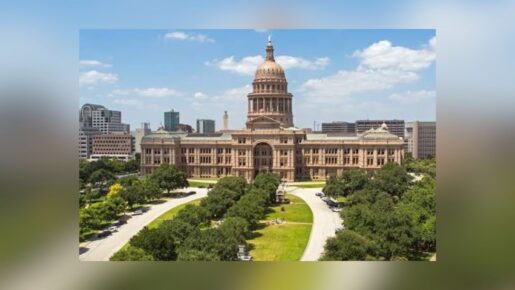
Texas still provides a clear example of the pledge’s place in schools. Education Code Section 25.082 requires daily recitation of the U.S. and Texas pledges in school districts and open-enrollment charter schools, with an exemption upon a parent’s or guardian’s written request.
McMahon’s announcement expressly recognizes constitutional protections and introduces no new federal mandate. Her request is to invite participation while respecting students’ rights.
Why the Push Now?
The department tied its appeal to Constitution Day, the nation’s 250th anniversary and weaknesses in civic learning.
The assessment figures it cites come from 2022: just 22% of eighth graders scored at or above NAEP Proficient in civics, and 13% reached that level in U.S. history. NAEP cautions that its proficiency benchmark is not the same as state-defined grade-level proficiency.
The push also arrives as Texas reshapes history instruction. As The Dallas Express previously reported, the State Board of Education completed a broader social studies revision emphasizing America’s founding and republican government.
For classrooms observing September 17, the pledge offers a starting point for a larger lesson: what the republic is, where its authority comes from, and which freedoms its government must protect.