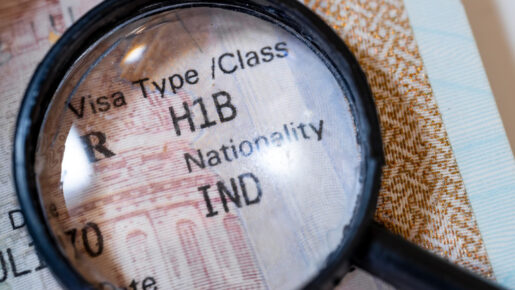


A Google-network backed Illinois congressman is pushing legislation to double the supply of H-1B visas, even as public criticism of the program has reached its sharpest point in years.
Democratic Representative Raja Krishnamoorthi of Illinois has reintroduced a bill that would raise the annual cap on H-1B visas from 65,000 to 130,000, a move arriving just days after federal officials received nearly 17,000 public comments from all political sides, many calling for reform or restrictions on the program.
The High-Skilled Immigration Reform for Employment (HIRE) Act comes amid escalating scrutiny of companies and institutions that rely heavily on temporary foreign labor.
Google, one of Krishnamoorthi’s top donor-affiliated entities, has secured 37,107 H-1B approvals over the past five years, according to figures listed in the H-1B data hub operated by U.S. Citizenship and Immigration Services.
Public universities and medical networks across Illinois that appear throughout the congressman’s donor rolls also depend extensively on foreign labor. The University of Illinois Chicago has had 928 H-1B workers approved since 2020. Northwestern University and its affiliated organizations, including the McGaw Center, have collectively employed more than 1,200 H-1B workers over the last five years, according to USCIS data.
Krishnamoorthi’s donor profile further underscores the program’s political weight. According to OpenSecrets, individuals and PACs affiliated with Google contributed $28,275 to his campaign committee in the 2023–2024 cycle, while Northwestern University-affiliated donors gave $39,504. The Indian American Impact, which has denounced recent restrictions on the visa program, contributed $20,000.
Indian American Impact has sharply opposed President Donald Trump’s September executive order imposing a $100,000 fee on most new H-1B visas. In a press release, a spokeswoman said, “Donald Trump’s $100,000 fee on H-1B visas is a direct attack on the very workers and communities who fuel America’s economy and innovation… This executive order is not about protecting American jobs; it is about weaponizing immigration policy to advance a xenophobic agenda.”
India receives tens of billions of dollars in annual U.S. remittances, and a recent Barclays report indicated that policy shifts could affect up to $5 billion of the country’s roughly $83 billion yearly total.
The reintroduction of the HIRE Act follows months of rising bipartisan concern about the visa system.
The Department of Homeland Security’s proposed rule to prioritize higher-wage applicants drew nearly 17,000 public comments before the November 24 deadline.
A review by The Dallas Express reported that hundreds of public comments were overwhelmingly negative or called for reform, with entities from both sides of the political spectrum separately arguing that the current system undercuts American workers and allows legal underpayment of foreign workers. Several commenters, including college students and representatives of advocacy groups, called for the program’s elimination entirely.
These developments came shortly before Trump announced that his administration would “permanently pause” migration from “Third World” countries, a declaration made after two National Guard members were shot near the White House, DX reported. The suspect in that case is an immigrant from Afghanistan, according to law enforcement statements.
Krishnamoorthi said the HIRE Act is “designed to strengthen America’s long-term economic and technological competitiveness,” per Newsweek. Supporters, including Raghu Chittimalla, the Governing Board Chair of ITServe Alliance, argue that chronic shortages in science and technology justify expanding, rather than contracting, the visa supply.
Opponents see the issue differently.
“It’s past time for Congress to end not only the numerous types of H-1B abuses, but also the administrative state creations that developed the student-to-H-1B-green-card pipeline that adversely affects American students and employees,” Simon Hankinson, of the Heritage Foundation, previously said.
The timing of the bill also contrasts sharply with a parallel effort led by Republican Senator Jim Banks, who introduced legislation in September to raise the H-1B minimum salary to $150,000 and replace the lottery with a bidding system. Banks said corporations “rigged the system to flood the country with cheap foreign labor and drive down wages,” DX reported.
Krishnamoorthi has argued that the HIRE Act would bolster U.S. competitiveness while supporting industries reliant on specialized workers. But with public sentiment shifting, administrative crackdowns underway, and the President’s broader immigration freeze looming over the debate, the proposal faces an uncertain path through Congress.