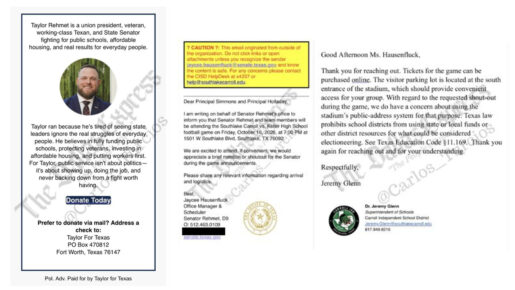


Editor’s Note – This is the first article in a mini-series detailing the circumstances and reactions surrounding Democrat Taylor Rehmet’s victory in the Texas Senate District 9 special election, which followed the resignation of former State Senator Kelly Hancock.
The Republican loss in Texas Senate District 9 has sparked an unusually public debate within GOP circles, as activists, donors, and political figures offer competing explanations for how a deep red Republican district former Senator Kelly Hancock last won by 20 points in 2022 elected a Democrat in Saturday’s special runoff election.
Democrat Taylor Rehmet defeated Republican Leigh Wambsganss in the Jan. 31 runoff, marking a flip of the seat following the resignation of former Texas Sen. Kelly Hancock. The result has prompted questions about turnout, candidate decisions, and what role the circumstances surrounding Hancock’s departure played in creating the conditions for an upset that some Democrats and national media outlets have framed as a warning sign for Republicans ahead of the November midterms, and as evidence that even historically red districts may now be vulnerable.
The runoff followed a November special election in which candidates from both major parties appeared on the same ballot, a format often referred to as a “jungle” election. In that system, no party primary is held, and if no candidate receives more than 50% of the vote, the top two finishers advance to a runoff regardless of party affiliation.
The special election was triggered after former District 9 Sen. Kelly Hancock resigned from the Texas Senate and was named chief clerk by Texas Comptroller Glenn Hegar, a role in which he assumed the duties of acting comptroller. Hancock is now running for the comptroller’s seat on a permanent basis in the March primary against former state Sen. Don Huffines and Texas Railroad Commissioner Christi Craddick.
As previously reported by The Dallas Express, Gov. Greg Abbott had explored whether appointing an interim comptroller could raise constitutional concerns under his own 2002 attorney general opinion. Ultimately, Hancock was not appointed by the governor but was hired by Comptroller Glenn Hegar, avoiding the Senate-confirmation issue raised in that earlier reporting.
Several Republican commentators criticized what they described as the process that placed Hancock in the acting comptroller role, arguing that his decision to leave the Senate seat and assume the interim position was intended to give him an advantage ahead of the March primary, where he is facing former state Sen. Don Huffines and Texas Railroad Commissioner Christi Craddick for the permanent comptroller position.

Kambree criticized former Sen. Kelly Hancock’s decision to leave Senate District 9, arguing on social media that the resulting special election contributed to the GOP loss | Screenshot via X

Republican attorney Adam Loewy warned that vacating the Senate seat could shape Kelly Hancock’s political legacy if Republicans fail to reclaim the district in November | Screenshot via X
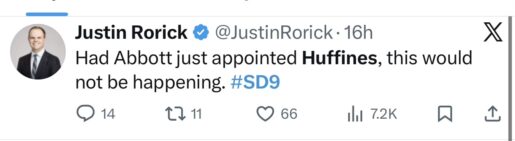
Justin Rorick argued on social media that Gov. Greg Abbott’s handling of the interim comptroller decision contributed to the conditions surrounding the Texas Senate District 9 runoff | Screenshot via X
Additional criticism centered on the timing of the election and its impact on turnout. GOP leaders attributed the low participation to limited public awareness of a special election held just weeks before the Super Tuesday primary, as well as a winter storm that disrupted early voting in parts of Tarrant County. DX will explore those factors and others later in this series.
Texas Senate District 9 includes portions of Tarrant County, including Fort Worth and surrounding suburban communities. The district has historically voted Republican in statewide and federal races, leading some Democrats to frame Rehmet’s victory as evidence of broader political shifts. Republican leaders, however, dispute that characterization.
Because the Texas Legislature is not scheduled to convene again until 2027, the winner of the runoff may have limited legislative activity during the remainder of the unexpired term. Wambsganss is unopposed in the March primary and is set to face Rehmet again in a traditional November general election.