

President Donald Trump on Tuesday shared an image of a novelty $100 bill featuring his portrait in place of Benjamin Franklin’s.
The post, shared on Truth Social, depicts a mock “Federal Victory Note” with Trump’s official portrait, signatures from Trump and Vice President J.D. Vance, and a serial number styled “TRUMP4547.”
The posted $100 image was explicitly a novelty/mock bill, not legal tender.
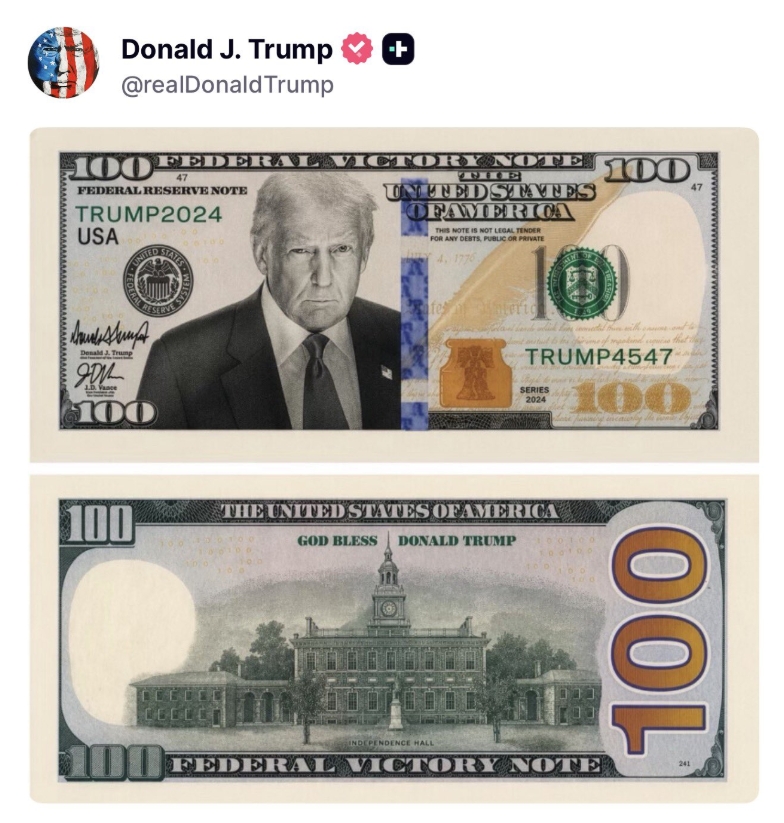
It is illegal under longstanding U.S. law to feature the portrait of any living person on United States paper currency and securities. This stems from the 1866 Thayer Amendment, which states: “Only the portrait of a deceased individual may appear on United States currency and securities.”
The image comes as the U.S. Treasury Department prepares to issue new $100 bills in June 2026 bearing Trump’s signature — the first time a sitting President’s signature will appear on U.S. paper currency.
According to the Treasury’s March 26, 2026 announcement, Trump’s signature will accompany that of Treasury Secretary Scott Bessent on future notes. The change replaces the U.S. Treasurer’s signature, a practice in place since 1861, and honors the nation’s 250th anniversary.
“The first $100 bills with the signatures of Trump and Treasury Secretary Scott Bessent will be produced in June, followed by other denominations in the coming months,” Reuters reported.
Rep. Brandon Gill (R-Texas) introduced the Golden Age Act, which would require Trump’s portrait on all future $100 bills. The Golden Age Act (H.R. 1790) currently remains in the Introduced stage. It was referred to the House Committee on Financial Services on March 3, 2025, and has not advanced beyond committee.
Current U.S. paper currency features portraits of Presidents and founding figures: George Washington on the $1, Thomas Jefferson on the $2, Abraham Lincoln on the $5, Alexander Hamilton on the $10, Andrew Jackson on the $20, Ulysses S. Grant on the $50, and Benjamin Franklin on the $100.
The last major update to a President’s portrait on circulating paper currency occurred decades ago. The current designs for these denominations have remained largely consistent since the 1920s and 1930s series, with security enhancements added in later decades, but no new Presidential portraits have been introduced.