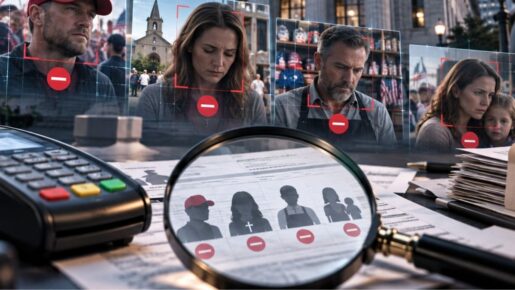
Federal immigration officials are proposing a significant expansion of biometric data collection throughout the immigration system. Supporters argue that this will enhance security, while critics warn it could jeopardize intelligence partnerships and civil liberties.
The U.S. Department of Homeland Security, through U.S. Citizenship and Immigration Services, published a Notice of Proposed Rulemaking on November 3, 2025, titled Collection and Use of Biometrics by U.S. Citizenship and Immigration Services. The proposal would amend existing regulations to require biometric submission from nearly anyone connected to an immigration benefit request, regardless of age. This includes applicants, petitioners, sponsors, and, in some cases, U.S. citizens and lawful permanent residents tied to filings.
Under the proposal, DHS would broaden the definition of biometrics beyond fingerprints and photographs to include palm prints, facial and ocular images, voice prints, and DNA, limited to partial profiles.
The rule would also remove existing age caps, authorizing collection from infants and elderly applicants, and institute “continuous vetting” of immigrants from the point of application through naturalization.
DHS’s proposal claims the changes are needed to deter fraud and bolster national security, arguing that biographical data can be falsified while biometrics are more reliable.
The agency estimates the rule would result in about 1.12 million additional biometric submissions each year. Total annual monetized costs are projected at roughly $288.7 million.
The proposal has drawn significant public attention, with an estimated 5,000 comments submitted thus far. The public comment period closes on January 2, 2026, at 11:59 p.m. Eastern.
Family scams have been a widely reported feature of the American immigration system for years, with aliens claiming to be a family unit, often with children with whom they have no relation, to receive preferential treatment. An ICE pilot program for rapid DNA tests in Texas showed that 30% of those tested were not related to the children they claimed to be theirs, the Washington Examiner reported in 2019.
One of the more detailed critiques came from the Truman National Security Project, which said the rule could weaken, rather than enhance, U.S. security.
In a comment posted December 23, 2025, the organization wrote that the proposal “would paradoxically weaken U.S. national security” by eroding trust with immigrant communities and diverting resources from higher-priority threats.
The comment argued that the rule’s “sweeping biometric collection, particularly DNA collection and indefinite retention” conflicts with European data protection laws such as the General Data Protection Regulation, potentially discouraging intelligence cooperation with other countries NATO.
It also warned that “continuous vetting” could deter human intelligence sources and that collecting biometrics from trafficking victims, domestic violence survivors, and children “advances no articulable national security interest.”
The comment further raised cybersecurity concerns, noting that biometric data cannot be changed if compromised and pointing to the 2015 Office of Personnel Management breach as an example of the risks of centralized databases. In that case, hackers made off with ID and security-clearance information about U.S. government staff, as well as millions of fingerprints, the BBC reported.
DHS has said the rule would be phased in and that exemptions could be announced through future Federal Register notices or form instructions. The department has emphasized that DNA would be used primarily to verify family relationships and that raw DNA samples would not be retained.
A similar biometrics proposal issued in 2020 was withdrawn the following year, after President Joe Biden took office. The current rule has been designated by the Office of Management and Budget as a “significant regulatory action” because of its projected economic impact.