



Chinese companies are testing flying taxis and deploying delivery drones in southern cities as Beijing pushes development of its “low-altitude economy” to fuel growth, according to reporting by the Associated Press. The futuristic vehicles face regulatory hurdles and technical limitations despite strong government support.
China aims to transform airspace below 1,000 meters into a $490 billion industry by 2035, but strict military controls and battery limits threaten to slow expansion.
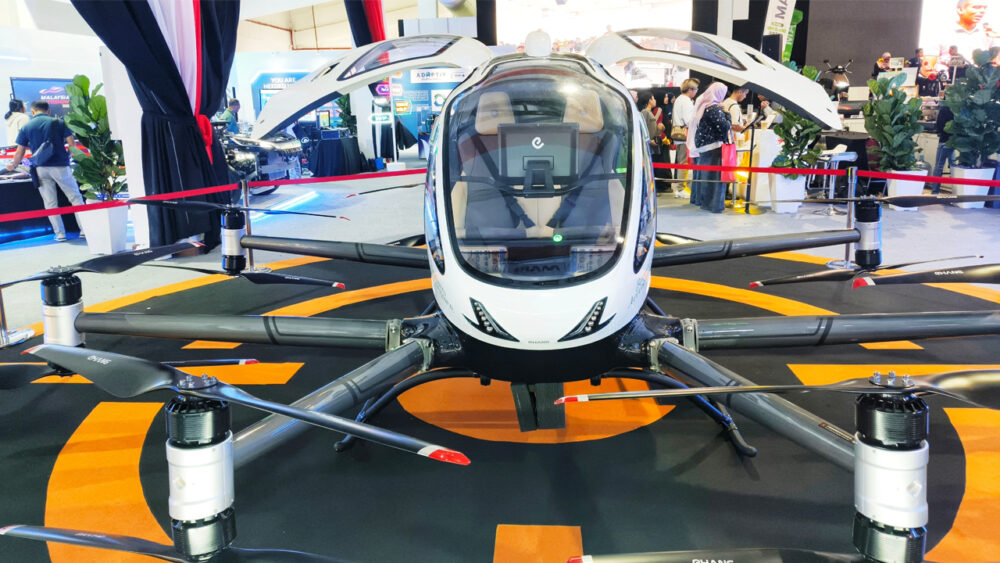
In Guangzhou, an unmanned oval-shaped craft from EHang hovers over a riverside innovation zone during trials. The electric vertical take-off and landing (eVTOL) vehicle whirs like a mini-helicopter, reaching speeds of 130 kph with a 30-kilometer range.
Nearby Shenzhen already integrates food-delivery drones into daily life. Polish tourist Karolina Trzciańska ordered bubble tea via a phone app, watching the drone arrive 30 minutes later through drizzle.
“This is the first time I’m seeing something like this, so it was super fun to see the food being delivered by the drone,” she said.
China’s low-altitude economy generated 506 billion yuan ($70 billion) in 2023, about 0.4% of the country’s GDP. By 2035, projections show it reaching 3.5 trillion yuan, said Zhang Xiaolan, a researcher at the State Information Center.
Guangdong province leads development. It is home to drone giant DJI, which controls an estimated 70% of global commercial drone markets. Other major players include EHang, SF Express’s drone division Phoenix Wings, and XPENG’s flying car unit ARIDGE.
The province announced plans for flight service stations and airspace platforms while offering support through locally issued discount vouchers. Shenzhen launched a 15-million-yuan ($2.1 million) award for companies earning passenger eVTOL certifications.
China’s Civil Aviation Administration granted EHang certificates for commercial passenger services with pilotless eVTOLs. The company has built takeoff and landing sites in 20 Chinese cities in the past two years.
He Tianxing, EHang’s vice president, expects citywide networks using rooftops of malls, schools, and parks as terminals within five years. “It can’t just be a research product, nor an engineer’s toy,” he said.
Battery life poses the biggest obstacle, said Guo Liming, co-founder of Skyevtol. His single-seat manned eVTOL, priced around $100,000, can only fly 20–30 minutes before requiring charging.
Safety concerns emerged in September when two XPENG eVTOL aircraft collided during an exhibition rehearsal. One caught fire while landing. No injuries occurred, but an expo canceled its demonstrations a week later.
XPENG has continued to promote its “Land Aircraft Carrier,” a six-wheeled ground vehicle with a detachable eVTOL. The company invested over $600 million and claims 7,000 global orders.
Even with strong industrial momentum, drone adoption remains limited. Less than one-third of China’s low-altitude airspace was accessible for general aviation in 2023, according to Zhang. China also has only about a tenth of the U.S. general aviation aerodromes.
Some firms see greater opportunity abroad. “Perhaps for some Southeast Asian countries, if I introduce these applications to them, their demand could explode,” said Frank Zhou, managing director at GBA Low Altitude Technology.
China’s military controls most national airspace but pledged to simplify approval procedures in Shenzhen and five other provinces. Proposed civil aviation law revisions would add a chapter governing low-altitude airspace and civilian operations.
Commercialization may accelerate around 2030, said Gary Ng, senior economist at Natixis. Tourism-focused eVTOL flights would likely launch before true flying taxi services.
While China is a latecomer, it now leads in small drone manufacturing and low-altitude investment, said Chen Wen-hua of the Hong Kong Polytechnic University. The Communist Party’s ability to mobilize regulators, universities, and industry gives the country an advantage. But safety, battery capacity, and public acceptance remain limiting factors.
“The future for the low-altitude economy is bright,” Chen said, “however, the road leading to that bright future might be treacherous.”