




Investment and immigration firms are increasingly marketing a high-cost investor visa as a way to bypass the uncertainty of the H-1B lottery, even as the program has a history of fraud and security concerns.
Advertisements reviewed by The Dallas Express show companies promoting the EB-5 Immigrant Investor Program as a more certain alternative to the H-1B visa, framing the shift as a way to avoid caps, lotteries, and employer dependence.
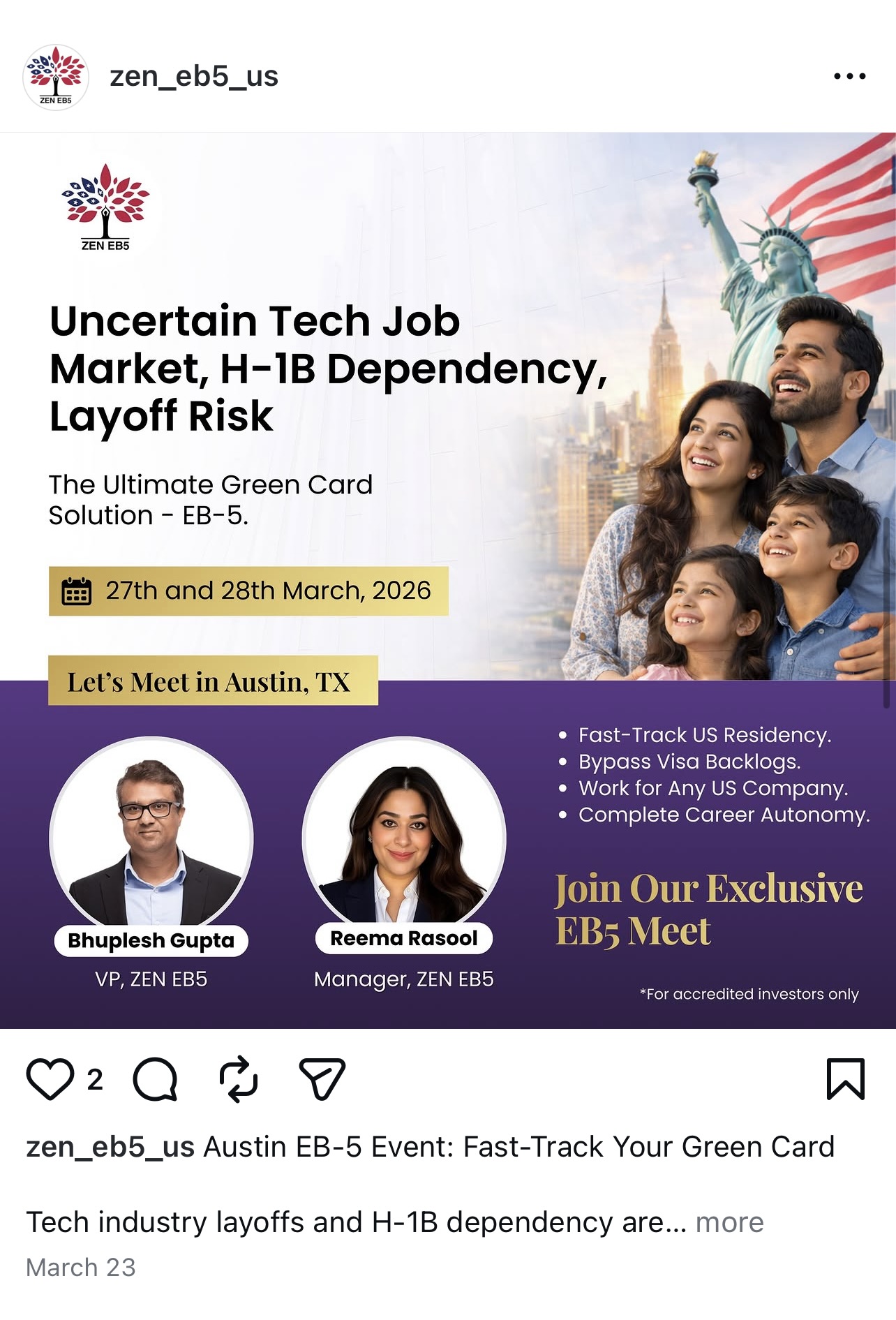
One recent Instagram ad from Zen EB5, a company that specializes in immigration-related investments, features what appears to be an Asian woman looking through binoculars reflecting images of Washington, D.C., and San Francisco, alongside the message: “Still Dependent on the H-1B Lottery? It is time to look beyond chance.” Another depicts a smiling Indian family posed in front of the Statue of Liberty and an American flag.
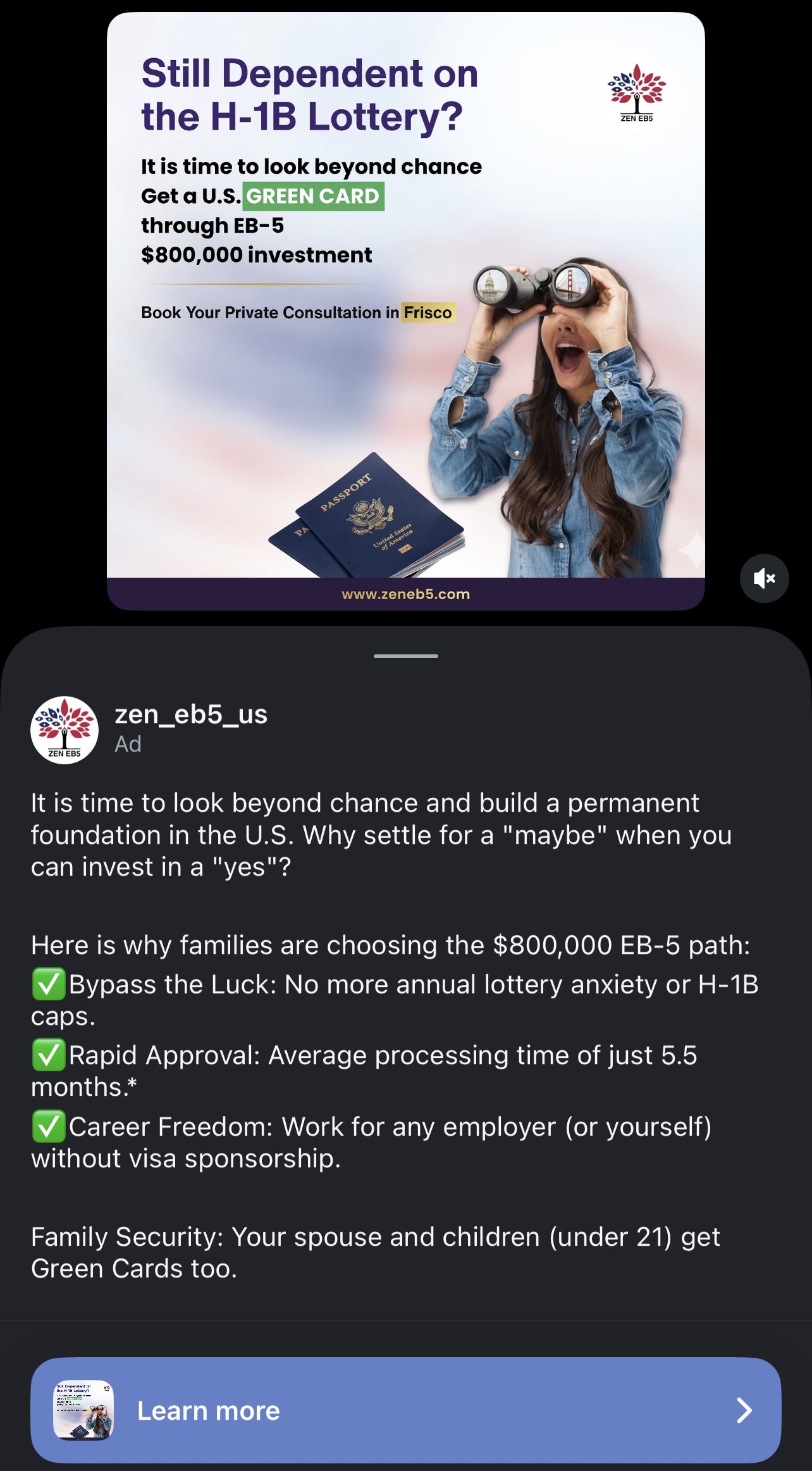
The ads promote a $800,000 investment pathway, promising “Rapid Approval,” “Career Freedom,” and green cards for spouses and children. They also advertise private consultations in Frisco. However, when The Dallas Express attempted to book a consultation, none were available, and it remains unclear why.
Additional promotions invited prospective investors to a March EB-5 event held in Austin, where company representatives pitched the program as “The Ultimate Green Card Solution” amid tech layoffs and visa uncertainty.
Other firms are using similar messaging. Ads from EB-5 Regional Center Golden Gate Global highlight that the visa allows applicants to “Experience More Control over Your Professional Growth and Salary Negotiation,” implicitly contrasting it with employer-sponsored visas.

The push mirrors a broader trend identified in a recent DX report, which found that firms are increasingly marketing alternative visa pathways, including the O-1A, directly to Indian professionals frustrated with the H-1B system.
Under federal law, the EB-5 program allows foreign nationals to obtain lawful permanent residency by investing $1,050,000 — or $800,000 in targeted employment areas — in a U.S. business that purports to create at least 10 full-time jobs, according to the Department of Homeland Security.
Supporters say the program brings significant economic benefits. Senator John Cornyn (R-TX) has defended it, previously stating, “EB-5 investments are a major economic driver in Texas. EB-5 projects use merit-based immigration to create thousands of American jobs and bring billions of dollars in investment to major urban areas like Dallas and Houston, as well as our rural communities across the state. These projects include investments in infrastructure for a wide variety of sectors, including energy, hospitality, residential and commercial.”
Cornyn also supported the 2022 omnibus legislation that revived and tweaked the EB-5 program after portions of it had temporarily lapsed under a sunset provision.
Critics, however, point to longstanding concerns about fraud, misuse, and national security risks tied to the program.
In February 2026, the Department of Justice announced that Sherry Xue Li was sentenced to 108 months in prison for orchestrating a $30 million fraud scheme that falsely promised foreign investors green cards through EB-5-linked projects. Prosecutors said more than 150 victims invested, but none received the promised immigration benefits.
Lawmakers have also raised national security concerns. A Department of Homeland Security memo obtained by Senator Chuck Grassley (R-IA) in 2013 warned of “concerns that this particular visa program [EB-5] may be abused by Iranian operatives to infiltrate the United States….” The memo alleged that some individuals involved “facilitate terrorism and are involved in an illegal procurement network that exports items to Iran for use by ‘secret’ Iranian government agencies.”
Between 2016 and 2021, the largest groups of petitioners for EB-5 visas were Chinese and Indian, per Government Accountability Office (GAO) data.
A 2023 GAO report found that in fiscal year 2021, confirmed EB-5 fraud and national security concern cases accounted for less than 1% of pending petitions. However, that figure was based on an unusually small pandemic-era applicant pool and included only confirmed cases among the then-pending filings.
Despite those concerns, the program continues to be marketed aggressively as a reliable alternative to capped work visas, often emphasizing certainty and control in contrast to the H-1B system’s lottery structure.
Whether that shift represents a legitimate pathway for investment-driven immigration or a rebranded workaround with its own risks remains a subject of ongoing debate among policymakers and enforcement agencies.
The H-1B visa is an employer-sponsored work visa that allows aliens to come to the United States to typically perform white-collar labor. The program, which primarily benefits Indian and Chinese nationals, is currently undergoing an executive overhaul, including a new 100,000 fee for many new H-1B petitions, and a number of proposed reform bills are pending in Congress, The Dallas Express previously reported.