



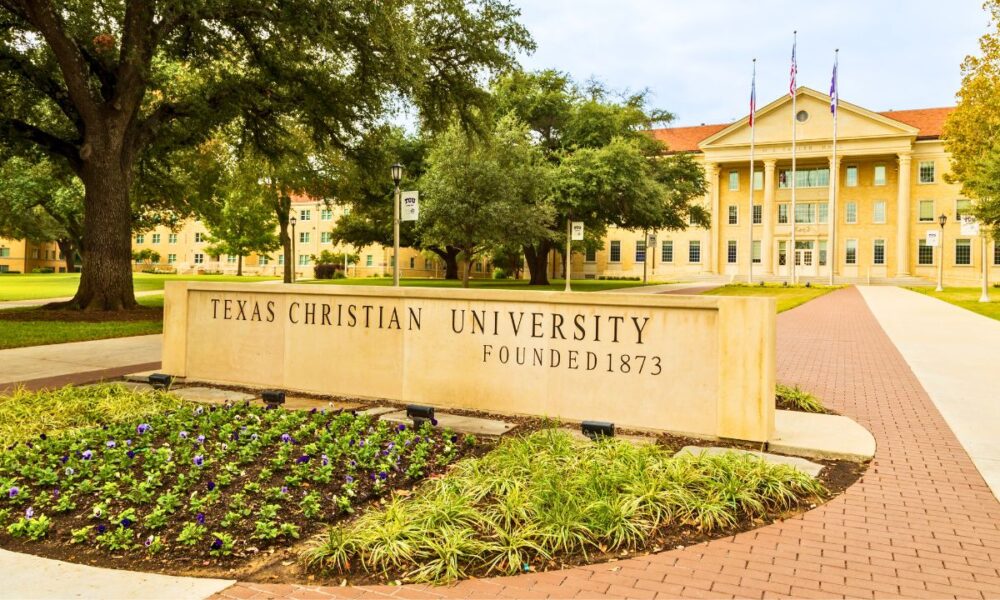
Texas Christian University will close its Comparative Race and Ethnic Studies (CRES) and Women and Gender Studies departments next year, merging both units into the English department due to low enrollment and a multi-year academic program review, university officials confirmed.
The restructuring will take effect on June 1, 2026. Students will still be able to take courses and complete degrees in both disciplines, but the departments themselves will no longer operate as standalone units.
In an October email to faculty, Provost Floyd Wormley Jr. said the move was necessary to “fulfill our obligation to ensure institutional fiscal sustainability” and ensure “a more efficient and effective use of faculty and administrative resources.”
Enrollment Numbers Remain Small
TCU’s internal data shows the two departments have some of the lowest major counts on campus:
- CRES: nine majors this fall
- Women and Gender Studies: two majors
TCU is also consolidating several additional units, including Spanish and modern languages, and geology and environmental sciences.
University spokesperson Greg Staley said the decision follows more than two years of reviewing course demand, class sizes, and enrollment trends.
“TCU is growing and will need more faculty and staff — not less — to ensure that we meet the academic needs of students and demand for a TCU education,” Staley said. “Decisions are not based on academic content nor on external pressure, but on data.”
Faculty Raise Concerns About Political Climate
Several faculty members argued that the consolidation aligns with a broader national and state environment surrounding courses related to race ideology, DEI, and “gender instruction.”
“It feels like a lot of what is happening is to potentially stay in the good graces of this political moment,” said Brandon Manning, an English professor affiliated with both departments.
Manning added that eliminating standalone departments removes a central “intellectual home” for students and makes the programs far less visible. “Now it will be extremely obscure,” he explained.
Part Of A Wider Trend
The move comes as universities across the state revisit programs and policies tied to race ideology, “gender studies,” and DEI —whether due to state law, federal guidance, or funding considerations.
Private universities have also made rapid adjustments:
- TCU shut down its DEI office earlier this year amid concerns about federal research funding.
- SMU paused its diversity course requirements in accordance with guidance from the U.S. Department of Education.
- UT Austin was selected by the Trump administration for new federal benefits under a revised higher education compact.
TCU is a private institution and not subject to the state law requiring public universities to review low-enrollment programs. However, faculty and analysts note that private campuses are not insulated from political, financial, or regulatory pressures.
Rebecca Sharpless, a history professor and chair of the Faculty Senate, said she views the response as TCU trying to navigate a rapidly changing oversight landscape. “What I see is an attempt to be nimble in a landscape that has changed dramatically in the last year,” she said.
DX Context: Similar Actions At Texas A&M
The restructuring follows a series of high-profile curriculum changes elsewhere in Texas.
As The Dallas Express previously reported, the Texas A&M University System recently barred faculty from teaching race ideology or material related to sexual orientation or “transgender” topics unless a university president grants explicit approval. The system also mandated strict adherence to approved syllabi.
A&M officials said the move aligned classroom instruction with system values, academic responsibility, and state and federal obligations.
National Trend Toward Program Consolidation
Higher education institutions nationwide continue to reassess small or specialized programs in response to enrollment shifts, changing student demand, and financial pressure.
“It absolutely could be enrollment pressures,” said Sondra Barringer, a professor at Southern Methodist University who studies university governance. “But with the complexity of the higher education landscape, it’s open to interpretation, unless administrators and decision makers are really clear about why they’re doing what they’re doing.”
Budget Questions Remain
TCU reported an operating budget of roughly $780 million this year and has signaled plans to expand its campus footprint and increase enrollment. Some faculty questioned why the institution would consolidate academic units during a period of growth.
“We’re in a growth mindset right now,” Manning said. “So it feels very directed.”