


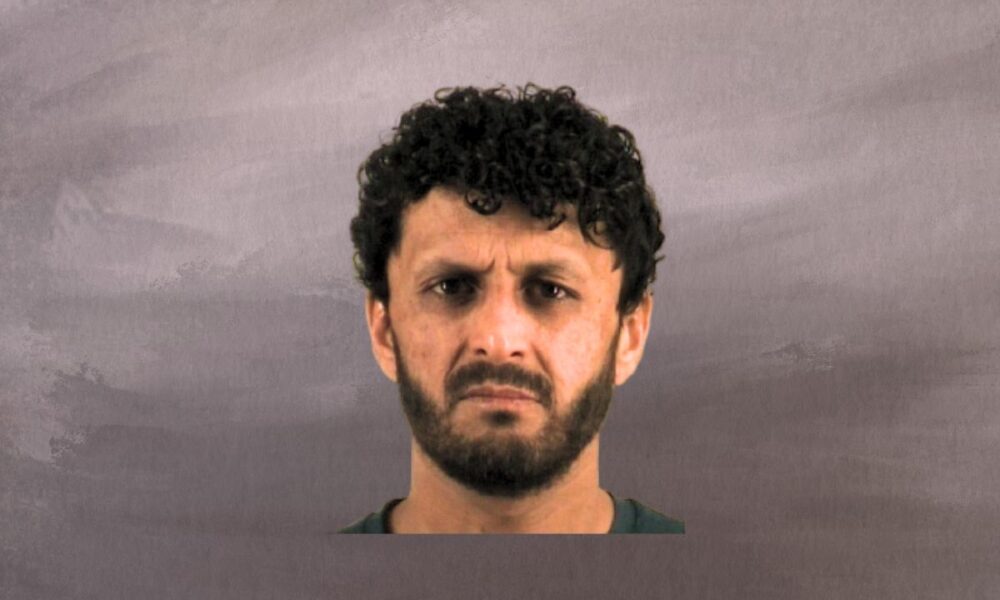
When police arrested an Afghan national for plotting to bomb the Fort Worth area, they labeled him “white.”
Mohammad Dawood Alokozay was arrested on November 25 for plotting to bomb a building in Fort Worth, announced the Department of Homeland Security Assistant. Secretary Tricia McLaughlin. He is an Afghan national who entered the country under former President Joe Biden’s “Operation Allies Welcome.”
Alokozay’s booking in the Tarrant County Jail lists him as “white,” as The Dallas Express reported.
He is currently being held without bail in the Lon Evans Corrections Center for a terrorist threat, impeding a public servant/fear of severe bodily injury/influencing government. ICE has placed him on an immigration hold.
The Dallas Express reached out to the FBI, but a media representative declined to comment on the case.
“Why can’t the government just be honest about this?” Tarrant County GOP Chair Tim Davis previously said to DX. “We’ll never solve the problem of crime in our neighborhoods if we can’t first be honest with each other about where it’s coming from. Republicans across Tarrant County and across Texas are asking for a simple thing – and that’s to just tell the truth.”
Texas DPS troopers arrested Alokozay just one day before another Afghan national, 29-year-old Rahmanullah Lakanwal, reportedly shot two West Virginia National Guard members on November 26 near the White House. One of the soldiers, U.S. Army Specialist Sarah Beckstrom, later died from her injuries.
Lakanwal has been charged with first-degree murder in that case. Like Alokozay, he entered under Biden’s “Operation Allies Welcome.”
The magnitude of the national security crisis Joe Biden unleashed on our country over the span of four years cannot be overstated. President Trump has directed his entire team to continue rooting out this evil within our borders. https://t.co/QdsTLFXauC
— Karoline Leavitt (@PressSec) November 29, 2025
A federal system has been in place for decades, which is likely why Alokozay was classified as “white.” Despite a 2024 policy revision, many agencies across America have yet to update their practices.
An Outdated System
Federal data guidelines have historically lacked a clear designation for Middle Eastern or North African offenders, making the specific crime data unclear.
While searching for inmates like Alokozay in the Tarrant County Jail, the database offers only four racial categories: white, black, Asian, and Indian.
Similarly, the Dallas County Jail database – which requires a “race” selection to search inmates – has only five options: white, black, Asian, Hispanic, and non-Hispanic.
Nationally, the FBI’s crime database also uses limited racial categories: white, black, Asian, American Indian or Alaska Native, Native Hawaiian or Pacific Islander, “Asian, Native Hawaiian, or Pacific Islander,” multiple, unspecified, and “unknown.” For ethnicity, it distinguishes between Hispanic/Latino and non-Hispanic/Latino.
White suspects are currently listed as the top offenders for aggravated assault at 1.44 million, with black suspects coming in second at 1.25 million, according to the FBI database. Meanwhile, white suspects are also listed as the top hate crime offenders, with black suspects in second.
These numbers, however, reflect decades-old race reporting practices.
The Office of Management and Budget first adopted Directive No. 15, setting “Race and Ethnic Standards” for federal reporting, in 1977.
At this point, officials set forth only four racial categories: White, Black, American Indian or Alaskan Native, Asian or Pacific Islander, and two ethnic categories: Hispanic or non-Hispanic. This left no room for Middle Eastern or North African offenders in crime reporting.
The OMB updated the guidelines in 1997 to five racial categories: White, Black or African American, Asian, American Indian or Alaska Native, and Native Hawaiian or Pacific Islander. It allowed reporting of multiple races and maintained the Hispanic/non-Hispanic distinction for ethnicity.
The revision still made no room for the Middle Eastern and North African ethnicity.
Many agencies continue to reflect these initial categories. According to the Safety and Justice Challenge, current practices often leave arresting officers to determine which race applies to a given suspect.
Closing The Loophole
The established system’s ambiguity has led to many questions about data accuracy.
Soon after Alokozay’s arrest, the popular X account “amuse” expressed concern about the FBI’s reporting mechanisms for hate crimes.
HATE CRIME DATA: FBI racial hate-crime data hides that nearly 50% of victims are white, 5,813 cases in 2024. The Bureau spotlights every group except whites. This is political data manipulation. Don't trust LLMs like ChatGPT and Grok when it comes to FBI hate crime statistics… pic.twitter.com/vrLJrGWjAB
— @amuse (@amuse) November 30, 2025
Years before, Ahmad Al Aliwi Alissa – who was born in Syria, then later became an American citizen – murdered 10 people in a Boulder, Colorado supermarket. According to The Washington Post, legacy media outlets initially reported he was “white” due to the long-standing racial guidelines.
In 2024, OMB updated the standards to close this loophole – adding “Middle Eastern or North African (MENA) as a minimum reporting category, separate and distinct from the White category.” It would also allow multiple responses and require more detailed data collection.
The new guidelines took effect on March 28, 2024, for all new record-keeping or reporting requirements. The OMB said officials should update existing requirements “as soon as possible,” but no later than March 28, 2029.
While this will likely require the federal government to update its crime reporting standards, the directive does not directly apply to local agencies. While some local agencies may follow suit, time will tell whether they update their practices for accuracy.