Student housing developments tied to investor visas are being marketed as a fast track to U.S. residency, raising new questions about how universities may indirectly shape immigration patterns.
Advertisements circulating on Instagram in recent weeks promote EB-5 visa investments in student housing projects as a way for foreign nationals, particularly those already in the U.S. on H-1B visas, to pursue green cards outside traditional employment pathways.
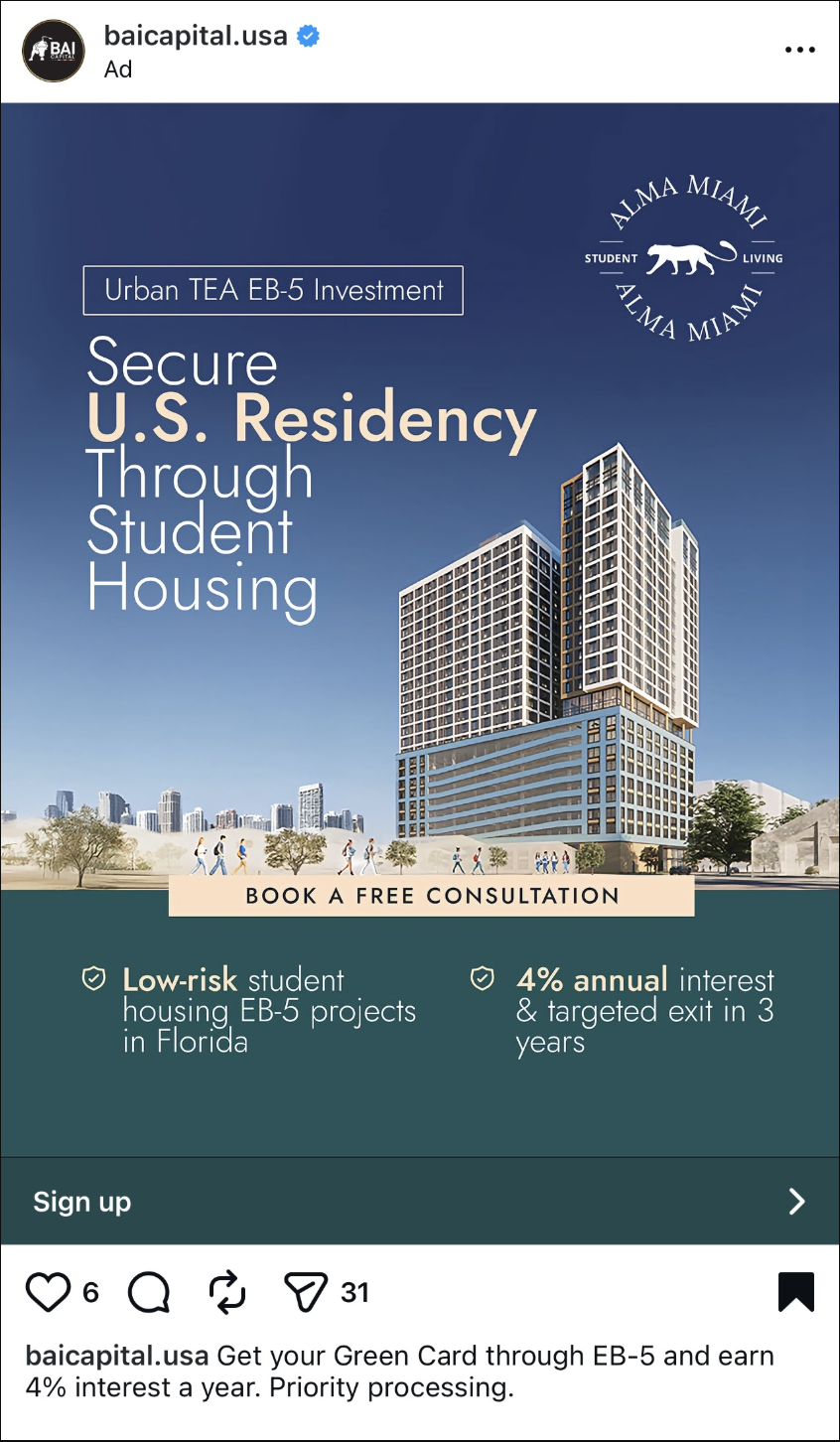
One ad from Bai Capital promotes “ALMA Miami,” a student housing project near Florida International University, offering a “low-risk” investment with a “4% annual return” and the promise to “Adjust your status in as little as 3 months.” Another urges viewers to “Secure U.S. Residency Through Student Housing,” framing the EB-5 Immigrant Investor Program as an alternative to employer-sponsored visas.
Click-through pages describe a 644-bed development within walking distance of campus, pitched as both a real estate investment and an immigration vehicle. The EB-5 program allows foreign nationals to obtain lawful permanent residency by investing at least $800,000 in targeted employment areas or $1.05 million otherwise in qualifying U.S. projects that create jobs.
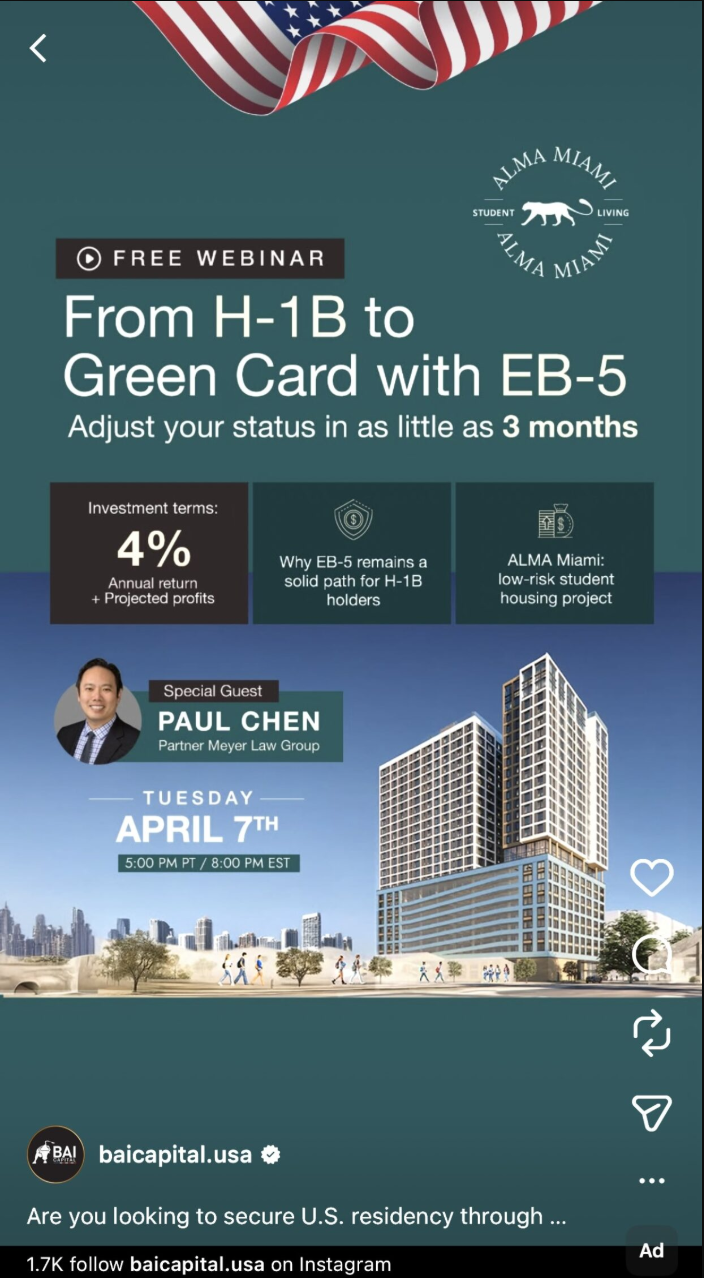
The marketing reflects a broader trend identified in a recent report by The Dallas Express, which found firms increasingly positioning EB-5 as an escape route from the H-1B lottery, emphasizing certainty and independence from employer sponsorship.
Supporters of the program argue it delivers economic benefits. Senator John Cornyn previously said, “EB-5 investments are a major economic driver in Texas… [they] create thousands of American jobs and bring billions of dollars in investment to major urban areas like Dallas and Houston, as well as our rural communities across the state.”
However, critics point to longstanding concerns. A Department of Justice case in 2026 resulted in a 108-month prison sentence for a woman who orchestrated a more than $30 million scheme that falsely promised foreign investors green cards through EB-5-linked projects, while past federal reviews raised national security concerns and questioned oversight.
Regarding purported job creation from EB-5 investments, a 2013 DHS Inspector General report found “USCIS is unable to demonstrate the benefits of foreign investment into the U.S. economy.” A 2023 GAO report later said USCIS had taken steps to assess fraud and national security risks but still lacked readily available data on some fraud trends and denial reasons.
The focus on student housing adds a new dimension to the debate. Unlike university admissions or hiring policies, which directly bring foreign students and workers into the country, these investment projects demonstrate how a university can stimulate immigration to an area without any direct involvement by anchoring demand for nearby developments that are marketed globally as immigration pathways.
Similar projects exist in Texas. A development near the University of Texas at Austin, backed by EB-5 funding, created 466 beds within walking distance of campus, according to the Texas Growth Fund.
Federal filings also show EB-5 capital was reported to be part of the backing for the Northpoint Crossing student housing project in College Station, near Texas A&M University.
The 2014 initial approval letter states, “99 immigrant investors will subscribe to the… [new corporate enterprise supporting the development] as limited partners in exchange for capital contributions of $500,000 each and an aggregate of $49.5 million.”
Between 2016 and 2021, the largest groups of aliens approved for EB-5 visas were Chinese and Indian, per Government Accountability Office (GAO) data.
These developments come as Texas universities face increasing scrutiny over their role in immigration-related programs. The Dallas Express previously reported that Texas A&M University spent more than $3.25 million on H-1B visa sponsorships since 2020, raising questions about hiring practices and labor priorities.
That report also noted that 72% of H-1B visas nationally go to workers from India and about 12% to workers from China, according to federal figures.
Debates over foreign labor pathways have intensified in recent months. Another DX report detailed calls from the Young Republicans of Texas to end the Optional Practical Training program, which allows foreign students at American universities to work in the U.S. after graduation.
Meanwhile, Governor Greg Abbott ordered a statewide freeze on new H-1B visa petitions at public universities and agencies in January 2026, citing concerns about abuse and workforce impacts.
The rise of EB-5-linked student housing marketing suggests a parallel channel emerging alongside these more visible programs. While universities may not directly sponsor these investments, their presence and the steady demand from both domestic and international students, can make surrounding real estate projects attractive vehicles for immigration-driven capital.
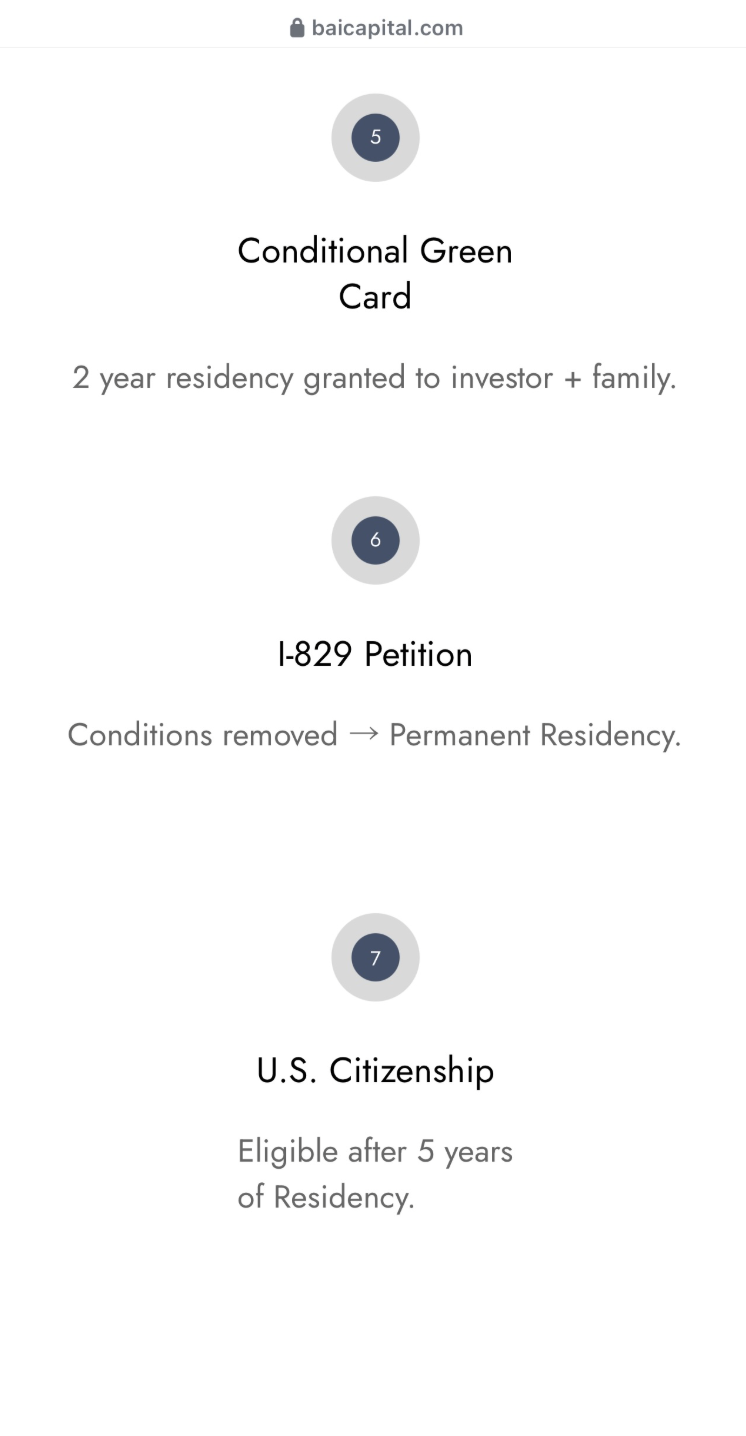
This can lead to permanent demographic shifts. One Bai Capital digital flyer explains that the EB-5 approval leads to a Green Card, which leads to “2 year residency granted to investor + family” and finally “U.S. Citizenship [,] Eligible after 5 years of Residency.”
Nevertheless, some of America’s most prominent business associations support the visa. Lawyers for the national Chamber of Commerce wrote in a 2022 legal brief, “The program produces billions of dollars of capital for the creation of new businesses and expansion of existing businesses, growing the American economy and generating job opportunities for American workers.”